
What is Blockchain Technology? A Beginner’s Guide
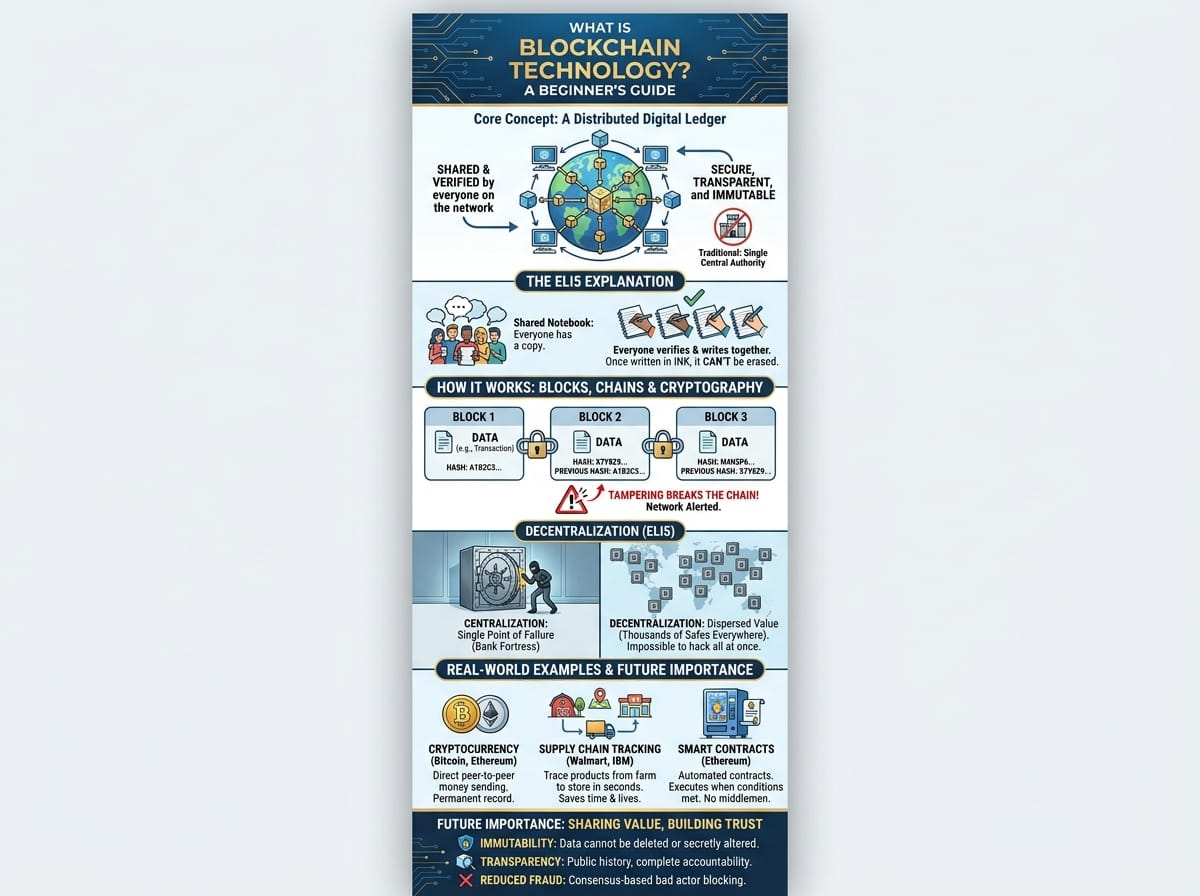
You have probably heard the term blockchain technology thrown around in conversations about Bitcoin, finance, or the future of the internet. But what exactly is it? At its core, a blockchain is simply a digital database or ledger that is distributed among the nodes of a computer network.
Unlike traditional databases, which are controlled by a single central authority (like a bank or a tech company), a blockchain is shared and verified by everyone on the network. This makes it incredibly secure, transparent, and almost impossible to hack or alter.
The ELI5 Explanation of Blockchain
ELI5 (Explain Like I’m 5): Imagine you and your friends are keeping track of who owes who money using a shared notebook. Every time someone borrows money, it gets written down. But instead of one person holding the notebook, everyone gets a copy. Whenever a new trade happens, everyone checks their copy to make sure the math is right, and then everyone writes it down at the same time. Once it is written in ink, it can never be erased. That shared, permanent notebook is a blockchain.
How Does a Blockchain Actually Work?
To understand how this technology operates, we need to break it down into its three main components: blocks, the chain, and the network. Understanding these elements is crucial to grasping why blockchain security is so highly regarded.
Blocks, Chains, and Cryptography
Information on a blockchain is stored in bundles called “blocks.” Each block contains a specific amount of data. When a block is full, it is sealed with a unique digital fingerprint called a hash.
Once a block is sealed, it is connected (or “chained”) to the block that came immediately before it. If a hacker tries to tamper with the information inside a block, the hash changes completely. This instantly breaks the connection to the next block, alerting the entire network that something is wrong.
Decentralization Explained (ELI5)
ELI5: Think of a traditional bank as a highly secure fortress. If a robber breaks into the fortress, they can steal the gold. That is centralization—one single point of failure. Decentralization is like taking that same gold, splitting it into tiny pieces, and hiding it in thousands of different locked safes all over the world. To steal the gold, the robber would have to break into thousands of safes at the exact same time. It’s practically impossible.
Real-World Examples of Blockchain
While often associated purely with digital money, the real-world applications of decentralized ledgers go far beyond that. Here are a few ways the technology is being used today.
Cryptocurrency (Bitcoin and Ethereum)
The most famous example is cryptocurrency. Bitcoin relies on blockchain to allow people to send money directly to one another across the globe without needing a bank as a middleman. Every single Bitcoin transaction ever made is permanently recorded on its blockchain.
Supply Chain Tracking
Companies like Walmart and IBM use blockchain to track food supply chains. If there is an outbreak of E. coli in lettuce, traditional databases might take days to trace the source. With a blockchain, the exact farm, truck, and distribution center can be pinpointed in seconds, saving time, money, and lives.
Smart Contracts
Networks like Ethereum allow for “smart contracts.” These are automated digital contracts that only execute when certain conditions are met.
Example: Imagine a digital vending machine. You put in a dollar, and the machine automatically gives you a soda. There is no cashier needed. A smart contract works the same way—if you pay a specific amount of crypto, the ownership of a digital asset (like a digital ticket or property deed) is automatically transferred to you without a lawyer or broker.
Why is Blockchain Important for the Future?
The internet fundamentally changed how we share information. Blockchain is poised to fundamentally change how we share value. By removing the need for middlemen, this technology reduces costs, speeds up transactions, and builds trust in a digital world where data manipulation is a constant threat.
Security, Transparency, and Trust
- Immutability: Once data is entered into a blockchain, it cannot be deleted or secretly altered.
- Transparency: Public blockchains allow anyone to view the transaction history, ensuring complete accountability.
- Reduced Fraud: Because the network relies on consensus (everyone agreeing the data is accurate), bad actors are easily identified and blocked.
Whether you are investing in crypto, managing a business supply chain, or just keeping up with modern technology, understanding the basics of blockchain is the first step toward navigating the future of the digital economy.