
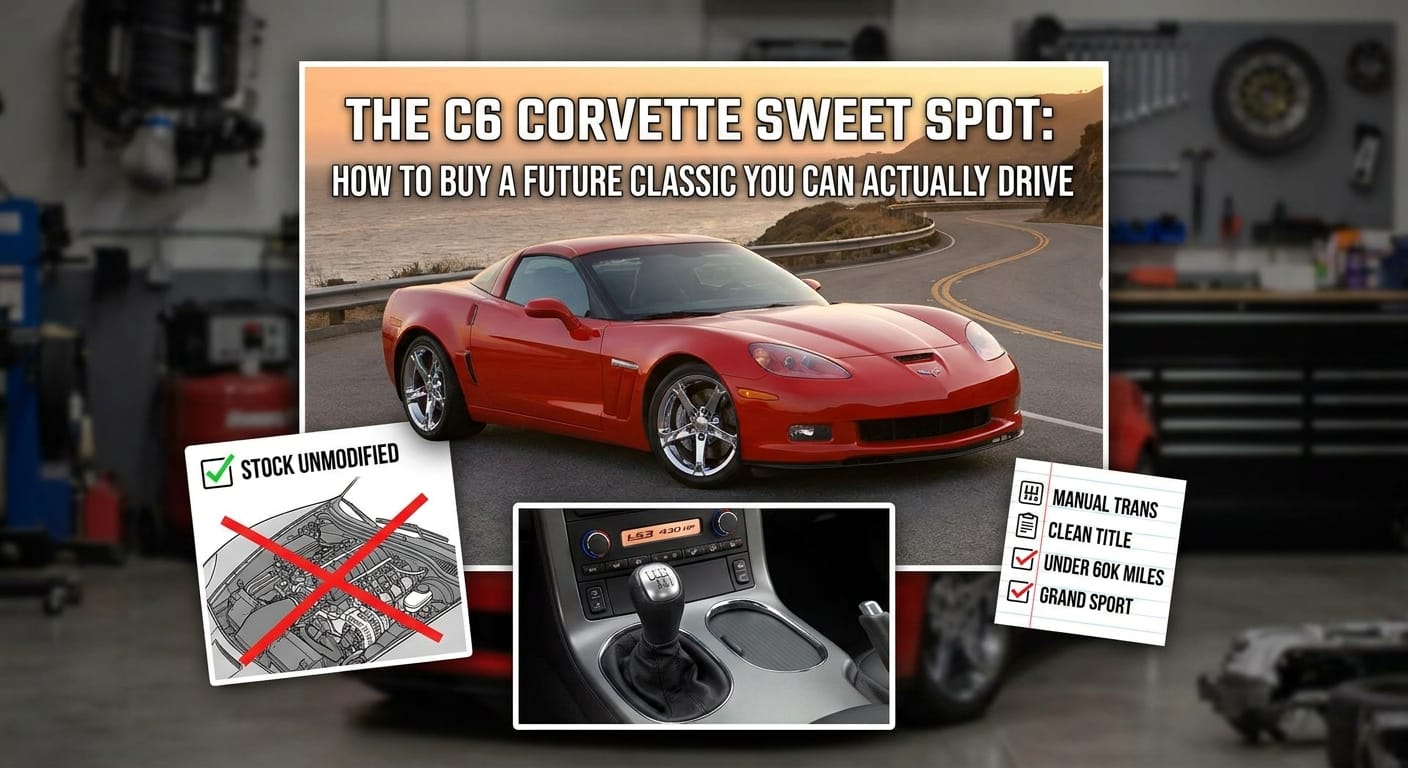
The C6 Corvette Sweet Spot: How to Buy a Future Classic You Can Actually Drive
It is a common rule in the automotive world that used sports cars are depreciating assets. You buy them, you drive them, and you eventually sell them for a fraction of what you paid. However, the 2008–2013 C6 Corvette is quietly proving that rule wrong. Backed by the legendary 430-horsepower LS3 V8 engine, these later-model C6s have steadily appreciated in value, with recent market data showing double-digit gains year-over-year.
But you can’t just buy any C6 Corvette and expect it to be a sound financial investment. The secret to buying a Corvette that holds its value—and pays you back in weekend thrills—comes down to strict spec discipline, avoiding heavily modified traps, and knowing exactly what to look for before you hand over your cash.
Why the 2008–2013 C6 Corvette is the Ultimate Sweet Spot
The C6 generation ran from 2005 to 2013, but the sweet spot for collectors and drivers alike starts in 2008. This was the year Chevrolet introduced the 6.2-liter LS3 V8, replacing the older LS2. The LS3 is widely considered one of the most reliable and capable V8s ever produced. It provides a massive 430 horsepower right out of the box, offering modern-day performance wrapped in a classic, aggressive silhouette.
Spec Discipline: How to Choose a C6 That Holds Its Value
If you want an investment-grade C6 Corvette, you have to be picky. The market heavily favors specific configurations, and compromising on these details can mean the difference between a car that appreciates and one that continues to lose value.
The Magic of the Manual Transmission
While automatic transmissions are convenient, a six-speed manual is mandatory if you are looking for long-term value. Manual transmissions are becoming increasingly rare in modern sports cars. Because of this scarcity, a three-pedal C6 commands a growing premium over its automatic counterpart.
Why the Grand Sport is the Smart Money
Introduced in 2010, the Grand Sport trim is the ultimate value play in the C6 lineup. It combines the bulletproof reliability of the LS3 V8 with the aggressive widebody styling, upgraded brakes, and track-tuned suspension of the higher-tier Z06. For example, parked side-by-side, a standard base model C6 looks noticeably narrower and less aggressive than a Grand Sport. You get the supercar looks without the supercar maintenance bills.
Mileage and the Clean Title Rule
Target a car with under 60,000 miles that comes with a documented maintenance history. More importantly, a clean title is absolutely non-negotiable. No matter how tempting the price tag is, you must walk away from salvage, rebuilt, or flood-history cars. The secondary market for branded titles is incredibly soft, meaning you will struggle to resell the car down the line.
ELI5: Why Stock Cars Outvalue Modified Cars
Explain Like I’m 5 (High School Edition): Imagine you are buying a used, high-end smartphone on eBay. Would you rather buy one that has never been opened, still has its original screen, and runs the factory software? Or would you buy one where the previous owner cracked it open, installed a louder aftermarket speaker, overclocked the processor so it gets extra hot, and installed custom, jailbroken software? Even if the modified phone technically has “faster” specs, you can’t guarantee the previous owner put it together correctly, making it a massive financial risk.
Cars work the exact same way. Stock, unmodified examples consistently outsell modified ones at auction because they represent a safe, predictable baseline. When you buy a Corvette with aftermarket camshafts, custom tunes, and bolted-on superchargers, you are inheriting someone else’s science project. Resist the temptation of “cammed-and-tuned” bargains; the market pays top dollar for factory originality.
Buying a Driver vs. a Museum Piece
The best investment-grade C6 is one you don’t have to trailer to car shows. While it might be tempting to hunt for a “museum piece” with only delivery miles, you will pay a massive premium for a car you can never actually drive without destroying its value.
Instead, look for a well-maintained “driver” in the 30,000 to 60,000-mile range. You will pay far less per mile of smiles. Adding a few thousand careful miles to the odometer each year won’t hurt resale value the way that total neglect and dry-rot will. Cars are meant to be driven; letting them sit for a decade destroys seals, hoses, and fluids.
Essential Pre-Purchase Steps and Known Issues
Even the most reliable sports cars have weak points. Knowing the platform’s trouble spots is what separates savvy investors from amateur buyers.
Common C6 Trouble Spots to Watch For
- Harmonic Balancer: The factory harmonic balancer is notorious for wobbling over time. If left unchecked, it can chirp, throw belts, or cause engine damage.
- Torque Tube Issues: Listen for rattling or excessive vibration from the drivetrain, which can indicate worn bearings inside the torque tube.
- Targa Top Seals: Check for dry or cracked weatherstripping around the removable roof panel, which can lead to annoying wind noise and water leaks.
- LS7 Valve Guides (Z06 Models Only): If you do decide to step up to the 505-hp Z06 model, be aware that the LS7 engine is famous for premature valve guide wear. If this hasn’t been addressed by a previous owner, you must budget to have the cylinder heads fixed immediately to prevent catastrophic engine failure.
The Importance of a Pre-Purchase Inspection (PPI)
Never buy a sports car based on photos and a test drive alone. Before finalizing the deal, budget $150–$300 for a Pre-Purchase Inspection (PPI) at a reputable, Corvette-savvy independent shop. A mechanic can put the car on a lift to check for hidden accident damage, leaking fluids, and the dreaded harmonic balancer wobble.
Protecting Your Future Classic
Buying the right 2008–2013 C6 Corvette is only the first step. To ensure it remains a depreciating-proof asset, buy the absolute best example you can comfortably afford. Keep a physical folder with every single service record, store the car in a climate-controlled garage, and use a battery tender when it’s not being driven.
If you stick to this formula—a clean-title, manual-transmission LS3 (preferably a Grand Sport) in stock condition—you will own something truly rare in the automotive world: a weekend toy that actually pays you back.