
The Billionaire Who Lives Like Your Neighbor: Inside Warren Buffett’s Financial Playbook
When you hear the name Warren Buffett, you likely picture one of the wealthiest people on the planet. With a net worth consistently hovering over $100 billion, it is easy to imagine a life of mega-yachts, private islands, and unlimited luxury. However, the “Oracle of Omaha” lives a financial life that contradicts every billionaire stereotype. The secret to his monumental wealth—and his peace of mind—lies in a surprisingly simple philosophy: he never sells his Berkshire Hathaway stock for personal income, he takes a remarkably low salary, and he lives extraordinarily below his means.
The Golden Rule: Never Sell Berkshire Hathaway Stock for Personal Income
Most corporate executives and founders regularly sell off portions of their company stock to fund their lavish lifestyles. Warren Buffett does the exact opposite. Despite owning hundreds of thousands of shares of Berkshire Hathaway, he refuses to liquidate his life’s work to pay for personal expenses.
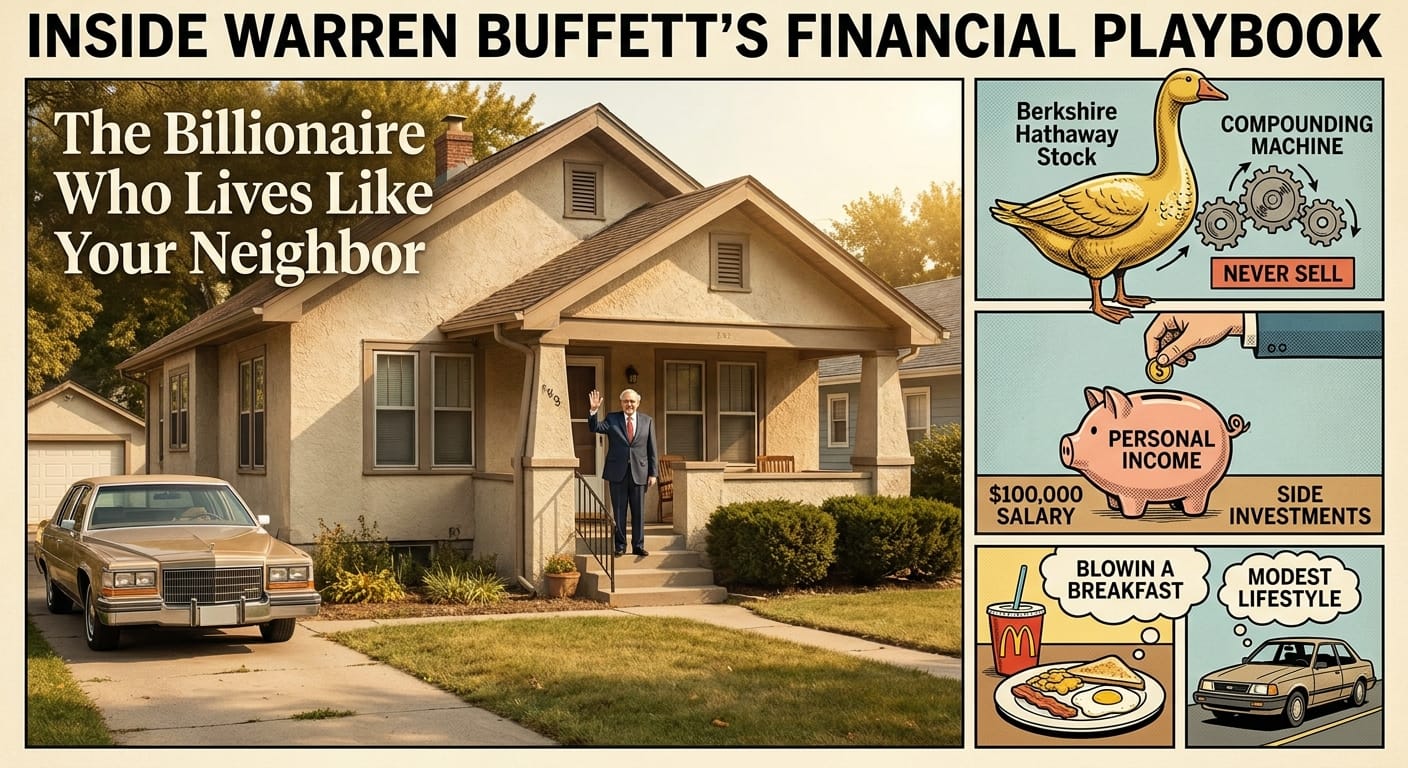
Buffett views his Berkshire Hathaway stock not as a personal ATM, but as a compounding machine that belongs to him and his shareholders. By leaving his money in the company, he allows his wealth to grow exponentially without triggering massive personal capital gains taxes or diminishing his voting power and influence.
Imagine you have a magical golden goose (Berkshire Hathaway) that lays golden eggs (profits). Most people would get greedy, chop up the goose, and sell the meat to buy fancy toys today. Warren Buffett, however, refuses to carve up his goose. He knows that if he just leaves the goose alone to do its job, it will keep growing and laying more eggs forever. By not selling pieces of his goose, he ensures it becomes the biggest, healthiest goose in the world.
What is Warren Buffett’s Actual Salary?
If he isn’t selling his billions of dollars in stock, how does Warren Buffett pay for his groceries, property taxes, and daily life? He relies on a traditional salary, but the number will shock you.
For more than 25 years, Warren Buffett’s annual salary as the CEO of Berkshire Hathaway has been exactly $100,000. He receives no massive cash bonuses, no stock options, and no restricted stock units. In a world where the average CEO of an S&P 500 company makes over $15 million a year, Buffett’s compensation is practically a rounding error.
Why Does He Take Such a Low Salary?
Buffett sets his salary at $100,000 to perfectly align his interests with his shareholders. He firmly believes that CEOs should be compensated based on the long-term success of the company, not short-term stock bumps. Because his true wealth is tied up in the exact same stock that everyday investors hold, he only gets richer if the shareholders get richer.
How Does Warren Buffett Generate Personal Income?
You might be wondering: Is $100,000 really enough for a billionaire to live on? For Buffett, yes. But his $100,000 salary is not his only source of cash.
Over his lifetime, Buffett has made smaller, personal investments outside of Berkshire Hathaway. For example, he has purchased farmland in Nebraska and commercial real estate in New York. These personal, outside investments generate passive income through rent, interest, and dividends. Furthermore, Buffett historically had a personal investment portfolio of stocks separate from Berkshire that paid him dividends.
Think of it like having two piggy banks. The giant piggy bank is his business (Berkshire Hathaway). He never takes money out of the giant piggy bank. But years ago, he bought a little lemonade stand and a small paper route using his own pocket money (his personal investments). Today, that lemonade stand and paper route give him enough cash every week to buy his lunch and pay his bills, so he never has to touch the giant piggy bank.
The Frugal Lifestyle: How Much Does He Actually Live Off Of?
Even with his $100,000 salary and personal passive income, Warren Buffett doesn’t need much money because his lifestyle is notoriously frugal. He does not desire the trappings of wealth, and his spending habits prove it.
The $31,500 House
While billionaires often collect mega-mansions around the world, Buffett lives in the exact same five-bedroom stucco house in Omaha, Nebraska, that he purchased in 1958 for $31,500. He calls it the third-best investment he ever made (after wedding rings for his first and second wives).
The Daily McDonald’s Breakfast
Buffett’s commute to the office takes five minutes, and he usually stops at McDonald’s. His breakfast budget is dictated by the stock market. He spends either $2.61, $2.95, or $3.17. If the market is down, he opts for the cheaper two sausage patties. If he is feeling prosperous, he springs for the $3.17 bacon, egg, and cheese biscuit.
Modest Vehicles
Buffett doesn’t employ a fleet of chauffeurs or drive imported supercars. He prefers to drive himself and usually buys American cars, such as a Cadillac, which he drives for years. He has even been known to buy cars that have cosmetic hail damage to get them at a steep discount, knowing the engine runs perfectly fine.
The Ultimate Lesson: Wealth is What You Don’t See
Warren Buffett’s financial structure is a masterclass in wealth preservation and personal finance. By never selling his Berkshire Hathaway stock for personal income, he allows compound interest to work its magic uninterrupted. By living off a modest $100,000 salary and a few personal side investments, he proves that true financial independence isn’t about how much money you spend, but how much money you keep.
For the everyday investor, the takeaway is clear: spend less than you earn, invest the difference in high-quality assets, and leave those assets alone to grow for as long as possible.