
For years, my investment process between earnings seasons consisted of a web browser buckling under the weight of fifty open tabs and a persistent, nagging feeling that I was missing something critical. The modern investor has access to an infinite stream of data, but without a rigorous system to process it, that data becomes noise.
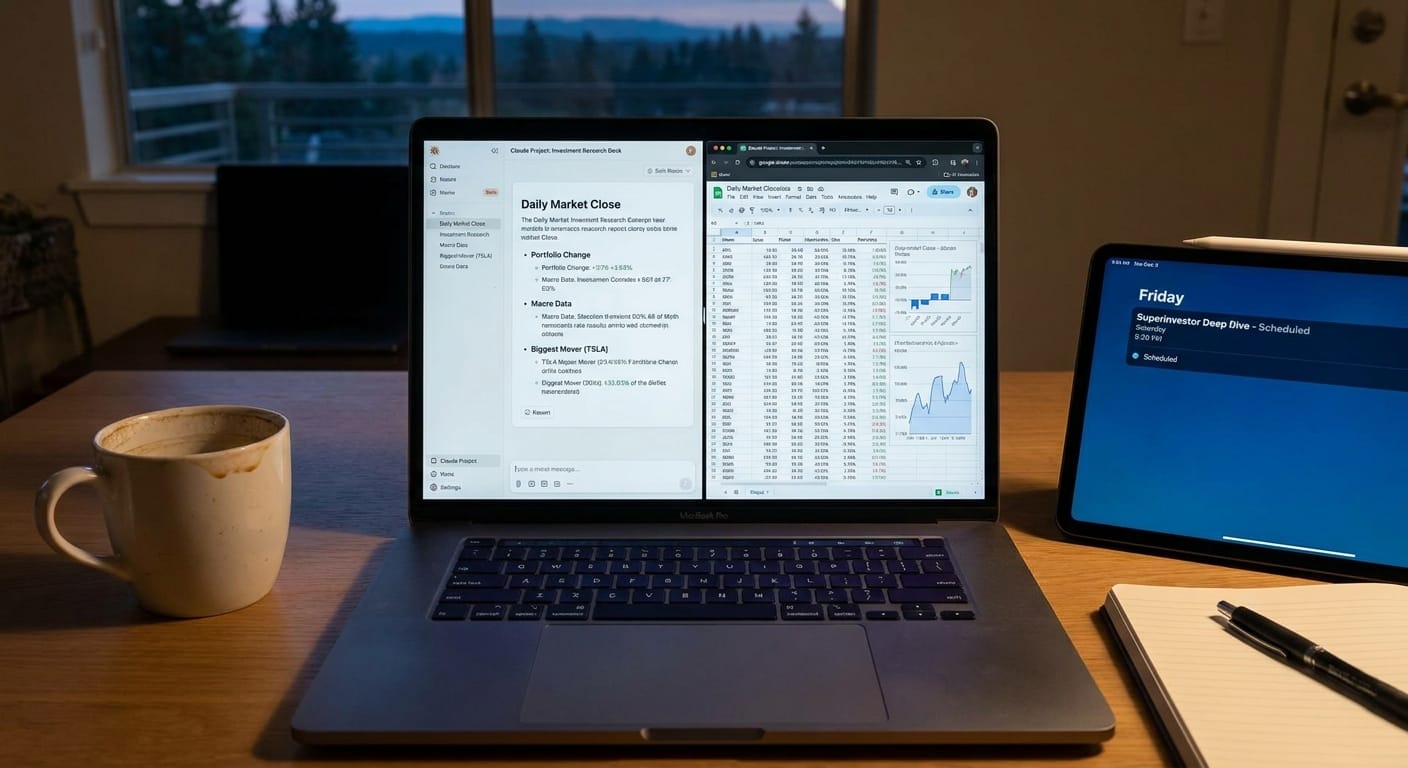
That completely changed when I stopped treating artificial intelligence as a simple chatbot that I query one question at a time, and started treating it as a programmable system that I could schedule. Using Claude’s Projects feature and recurring scheduled tasks, I built an automated investment research desk that essentially runs itself. It acts as a defined, secure workspace that knows my portfolio, reads from a single source of truth, and quietly does the same disciplined homework every single trading day and every Friday afternoon.
It never gets tired. It never skips a day because it is busy. Most importantly, it surfaces the data and the signals, but leaves the actual investment decisions exactly where they belong: with me. Here is exactly how I built it, how you can structure the AI to do the same, and the guardrails you need to keep the data honest.
The Foundation: Setting Up the AI Research Desk
To make this work, Claude needs context, boundaries, and a schedule. The goal is to move away from ad-hoc prompting and toward a structured environment. This is achieved by setting up a dedicated Project with a central source of truth.
Creating the Canonical Holdings File
The entire system relies on a single document: the canonical holdings file. I created a simple, structured text file that the AI references during every run. This file contains:
- Ticker symbols for every company I own or am actively watching.
- Share counts and cost basis so the AI can calculate dollar-value impact.
- My intrinsic value estimates for each stock, which gives the AI a baseline to compare against current market prices.
- Open questions or thesis notes (e.g., “Watch for margin compression in Q3” or “Did the new CEO address the debt load?”).
The Daily Market Close Routine
The backbone of this system is a daily weekday task scheduled to run shortly after the market closes. Consistency is the most powerful tool in investing, and this automated routine ensures my portfolio is analyzed exactly the same way every afternoon.
During this daily run, Claude executes a specific set of instructions:
- Reads the holdings file to understand my current exposure.
- Pulls the day’s index closing numbers and the 10-year Treasury yield to establish the macro environment.
- Checks a predefined macro calendar for market-moving events on deck, such as Federal Reserve rate decisions, CPI/PCE inflation prints, or upcoming jobs reports.
- Computes my portfolio’s dollar and percentage change for the day, isolating and flagging the single biggest mover in either direction.
Connecting Claude to Google Sheets for Compounding Data
An AI that just spits text onto a screen is only mildly useful. To make this a true research desk, the data must be recorded, charted, and searchable. I wanted Claude to write its findings directly into a Google Sheet I own.
Automating the Data Entry
Instead of manually copying and pasting the AI’s daily output, I set up a connector using the Model Context Protocol (MCP) to allow Claude to append rows directly to my spreadsheet. Every trading day, the AI writes one neat row containing the date, the macro metrics, my portfolio’s performance, the biggest mover, and upcoming catalysts. Over several months, this transforms into a highly searchable, chartable history of exactly how my portfolio behaved and why.
Imagine Claude is a highly skilled librarian who works inside a closed room. The librarian can read all your books and summarize them perfectly, but the door is locked, so they can’t put the summary notes directly into your filing cabinet (your Google Sheet) down the hall.
The Model Context Protocol (MCP) acts as a secure mail chute between the locked room and your filing cabinet. It is a specific set of rules that gives the librarian safe, limited permission to slide a piece of paper down the chute so it lands exactly in the right folder. To make this work automatically on a schedule, you have to “pre-approve” the mail chute—meaning you give the system permission in advance. If you don’t do this, the system will pause and wait for you to manually push a button to approve the transfer, which defeats the purpose of having it run automatically while you are away from your computer.
Advanced Income Strategies and Weekly Deep Dives
While the daily run handles the portfolio maintenance, the system truly earns its keep by automating complex research and income setups that would otherwise take hours of manual screening.
The Options-Income Overlay
As part of the daily routine, Claude scans my positions for options-income setups. It specifically looks for covered-call and cash-secured-put opportunities. The AI is instructed to flag these setups only when specific conditions are met:
- Elevated Implied Volatility (IV): The system highlights when option premiums are unusually rich due to broader market fear.
- Upcoming Catalysts: It flags stocks heading into earnings where a cash-secured put might offer an attractive entry point if the stock dips.
- Account Nuances: The AI separates setups based on account types, acknowledging that strategies in a tax-advantaged retirement account require different risk parameters than a standard brokerage account.
The Friday Superinvestor Deep Dive
Every Friday after the close, a second scheduled task runs. This is designed for value investing research. The AI tracks capital allocators with proven track records—investors like Chris Hohn, Buffett, Ackman, and Pabrai.
The AI scans the past week for new SEC 13F filings, activist letters, verifiable interviews, and public commentary from these investors. It then runs a valuation check-in, comparing my own intrinsic-value estimates (from the canonical file) against the current market quote. If a stock I want to own dips significantly below my calculated intrinsic value, it flags the discrepancy.
This weekly deep dive is logged in a separate tab in my Google Sheet. Reading down this single column allows me to see, week after week, what the best capital allocators in the world are quietly doing, alongside the status of my own investment theses.
Guardrails: Keeping the AI Honest
Large Language Models are prone to hallucination. If you ask an AI to find news, it might invent news just to please you. To prevent this, the research desk operates under strict, non-negotiable guardrails.
The “No Material Update” Rule
The most important instruction programmed into the AI is the mandate to force sourced, verifiable output. I explicitly command the system to output the exact phrase “No material update this week” if it cannot find concrete data from an SEC filing, a company press release, or a major financial data provider. It is trained that a boring, empty report is vastly superior to an invented one.
Acknowledging System Limitations
An automated AI desk is incredibly powerful, but you must build it with a clear understanding of its limits:
- Pricing Lag: Web-pulled prices via AI search are not a live Bloomberg terminal feed. They are snap-shots, which is why this system runs after the market closes, utilizing end-of-day data.
- The 13F Delay: The AI tracks SEC 13F filings to monitor superinvestors, but these filings legally lag by up to 45 days after the end of a quarter. The AI surfaces the data, but I must contextually remember that the trade happened in the past.
- The Human Element: The AI surfaces the signals. I decide what to do with them. You must still verify investor moves yourself before committing capital.
The True Value is Unbreakable Consistency
The real payoff of this system is not that the machine is a stock-picking genius. The payoff is that the machine is consistent, and consistency is the exact point where most human investors fail.
The AI never skips a Friday afternoon review because it wants to start the weekend early. It never gets bored of reading dense 13F filings. It never lets a portfolio valuation metric drift out of date because I forgot to update a cell in a spreadsheet.
What this system produces is a compounding trail of data and a weekly forcing-function to make me think critically about my holdings. It does not generate a set of orders to follow blindly. I still read the primary sources, I still make the final calls, and I still own every mistake. However, by acting as a tireless research desk that shows up every single day, Claude has quietly made me a significantly more disciplined, informed, and organized investor.