

In today’s fast-paced digital landscape, understanding the core concepts of artificial intelligence (AI) and how they process information is becoming essential. One of the most fascinating aspects of modern AI is the use of Neural Networks. Because search engines increasingly use these technologies to rank content and understand user intent, learning how they operate is a crucial step for mastering technical SEO and future-proofing your digital presence.
What is a Neural Network?
A neural network is a computing system designed to recognize patterns. It is a subset of machine learning and is at the heart of deep learning algorithms. By mimicking the way biological neurons signal one another, artificial neural networks can process complex data inputs like text, images, and user behaviors to produce highly accurate outputs.
How Neural Networks Work
Neural networks are built using layers of artificial “neurons” or “nodes.” Data travels through these layers, being weighed and transformed, until it reaches an output. Understanding this architecture helps us understand how search engines like Google process massive amounts of search queries to deliver the exact answer a user is looking for.
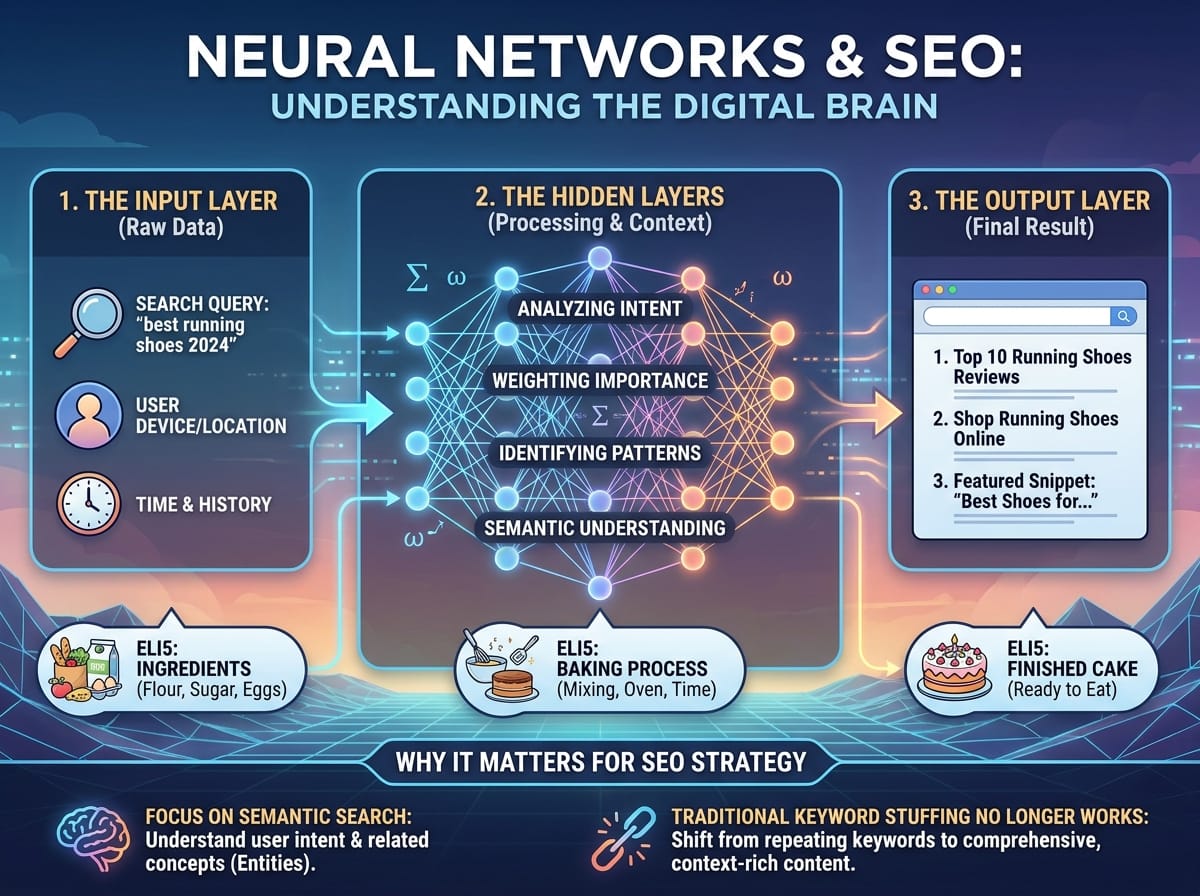
1. The Input Layer
The input layer is the entry point for the data. In search engine algorithms, this data could be the words in a search query, the physical location of the user, or the historical click-through rate of a webpage.
ELI5 (Explain Like I’m 5): Imagine you are trying to bake a cake. The input layer is your grocery bag. It holds all the raw ingredients you brought into the kitchen—flour, sugar, eggs, and butter. At this stage, it’s not a cake yet; it’s just raw information waiting to be mixed together.
Example: If a user types “best running shoes 2024” into a search bar, the input layer receives those specific words, the device being used (mobile or desktop), and the time of day.
2. The Hidden Layers
Once data passes the input layer, it moves into the hidden layers. This is where the actual “thinking” and processing happens. The network applies mathematical weights to different pieces of data to figure out which inputs are the most important.
ELI5: Let’s go back to baking the cake. The hidden layers are the steps in your recipe and the time spent in the oven. You have to mix the eggs and sugar first, then gently fold in the flour, and bake it at exactly 350 degrees. You can’t see what’s happening inside the oven, but that hidden process transforms the raw ingredients into something entirely new.
Example: In our search query example, the hidden layers analyze the phrase “running shoes.” It mathematically calculates that “running” implies an activity, “shoes” implies footwear, and “best” implies the user wants reviews or high-rated products, rather than a Wikipedia article about the history of shoes.
3. The Output Layer
After the data has been processed and weighted by the hidden layers, it arrives at the output layer. This is the final decision, prediction, or result generated by the system.
ELI5: The output layer is the finished, frosted cake sitting on your kitchen counter, ready to be eaten. It is the final result of all your ingredients and baking steps.
Example: For the search engine, the output layer is the actual Search Engine Results Page (SERP). It displays a ranked list of the top 10 sneaker review websites, shopping links, and a featured snippet answering the query perfectly.
Why This Matters for Your SEO Strategy
Because modern search algorithms utilize neural networks to process data, traditional keyword stuffing no longer works. Search engines no longer just look for matching text; they understand context, tone, and user intent.
Focus on Semantic Search
Semantic search refers to a search engine’s attempt to generate the most accurate results possible by understanding search intent, query context, and the relationship between words.
ELI5: If you say “I’m freezing,” a smart friend won’t just hand you a thermometer to show you the temperature. They will hand you a blanket. Semantic search is the search engine acting like that smart friend—understanding what you actually need, not just the words you said.
Example: Instead of writing an article that repeats the exact phrase “best running shoes” 50 times, an SEO-optimized post should include related concepts (entities) like “marathon training,” “arch support,” “breathable mesh,” and “sole durability.” The neural network recognizes these related concepts and boosts your page’s authority on the topic.
Conclusion
By understanding how neural networks and machine learning shape modern algorithms, you can pivot your SEO strategy from merely targeting keywords to actually answering user questions. Create comprehensive, context-rich content that satisfies the hidden layers of search engines, and you will naturally rise to the top of the output layer.