
The Quality Gauntlet: What All Five Masters Agree On
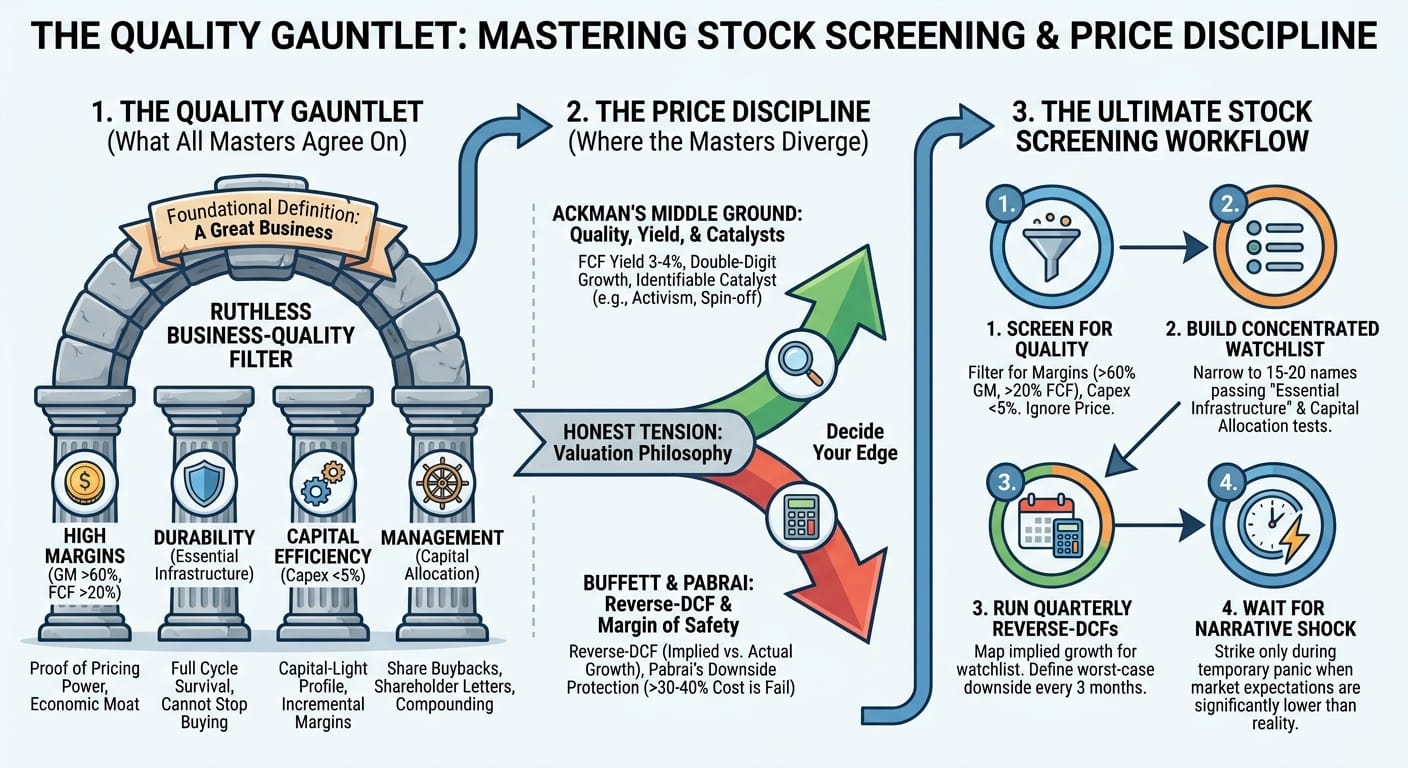
Before the price of a stock ever enters the conversation, a company must survive a ruthless business-quality gauntlet. Warren Buffett, Chris Hohn, Rajiv Kantesaria, Bill Ackman, and Mohnish Pabrai all practice vastly different styles of investing—ranging from activism to deep value—yet their foundational definition of a “great business” is virtually identical. A stock must pass these four fundamental tests to earn the right to be valued.
High Margins as Proof of Pricing Power
Start with the raw economics. The primary filter for a world-class business is a gross margin above 60% and a free cash flow (FCF) margin above 20%. Why these specific numbers? High margins are the undeniable fingerprint of pricing power, which is Rajiv Kantesaria’s non-negotiable metric. Pricing power is the observable, mathematical evidence of Warren Buffett’s famous “economic moat.” If a company can routinely raise prices without losing customers—think of how Visa or Mastercard operate—inflation becomes a tailwind rather than a threat.
Durability and the “Essential Infrastructure” Test
Next, test the company’s durability. Has the business survived at least one full economic cycle without diluting shareholders or taking on dangerous debt? Chris Hohn looks for what he calls “essential infrastructure.” This means selling something that customers are practically forced to keep buying, regardless of the macroeconomic environment. This is exactly why Hohn favors financial exchanges (like the London Stock Exchange) and ratings agencies (like Moody’s or S&P Global) over discretionary consumer brands. When times get tough, people stop buying designer handbags, but corporations cannot stop paying for credit ratings.
Capital Efficiency and Incremental Margins
Growth is only valuable if it doesn’t cost a fortune to achieve. Capital expenditures (Capex) should represent a very small fraction of total revenue—ideally under 5%. This capital-light profile is exactly what Kantesaria and Buffett prize, often found in software or franchise models. Furthermore, you must evaluate incremental margins: when the company’s revenue grows by one dollar, how much of that specific dollar falls straight to operating income? If a business requires massive new factories to generate its next million dollars in sales, it fails the capital efficiency test.
Management and Capital Allocation
Finally, you must evaluate the people steering the ship. The best way to do this is to read five years of shareholder letters and track their share buyback history. Did management aggressively buy back stock when it was cheap, or did they only authorize buybacks at market peaks to artificially boost earnings per share? Capital allocation is the only management skill that truly compounds over decades. An excellent example is AutoZone, a company that has masterfully cannibalized its own share count at opportunistic valuations for years.
The Price Discipline: Where the Masters Diverge
Here is the honest tension in the stock screening process: the five masters perfectly agree on what a great business looks like, but they violently disagree on what to pay for it. Your personal investment process must decide which pricing philosophy you are going to exploit to find your edge.
Ackman’s Middle Ground: Quality, Yield, and Catalysts
Bill Ackman’s approach offers the most practical middle ground for active investors. He looks for quality at a reasonable price, which translates to a free cash flow yield of 3% to 4% (or better) on a business that is growing its FCF at double-digit rates. However, Ackman demands an identifiable catalyst to close the valuation gap. This could be an upcoming licensing renewal, a predictable margin recovery, or activist levers (like replacing a CEO or spinning off a division). You aren’t just waiting for the market to wake up; you are buying into a mechanical event that forces the stock price higher.
Buffett and Pabrai: The Reverse-DCF and the Margin of Safety
Buffett and Pabrai demand a much stricter entry price. Rather than forecasting the future to justify today’s price, they run a “Reverse-DCF” (Discounted Cash Flow) on every candidate.
ELI5: The Reverse-DCF
Imagine you are looking at a math equation where you already have the final answer, and you need to figure out what starting numbers were used to get there. Usually, Wall Street analysts try to guess how fast a company will grow (the starting numbers) to figure out what the stock price should be today (the final answer). A Reverse-DCF flips this backward. You take today’s actual stock price (the final answer) and calculate exactly how much growth the stock market is expecting. If the current stock price shows that the market expects the company to grow by only 10% a year, but you know the company is easily growing at 20% a year, you have found a bargain. That gap between low expectations and high reality is your safety net.
Pabrai’s Final Filter: “Heads I Win, Tails I Don’t Lose Much”
Mohnish Pabrai adds the final, harshest filter to the valuation process. Before calculating how much money you can make (the upside), you must write down a highly plausible worst-case scenario and the exact dollar price that scenario implies. If a realistic “bad case” costs you more than 30% to 40% of your investment, the stock fails. It does not matter how beautiful the business is. If the downside is catastrophic, the correct action is to put the bat on your shoulder and wait for a fatter pitch.
The Ultimate Stock Screening Workflow
To put the wisdom of Buffett, Hohn, Kantesaria, Ackman, and Pabrai into practice, you need a disciplined, repeatable routine. Follow this practical workflow to separate buying great companies from overpaying for great stories:
- Step 1: Screen for Quality First. Use a stock screener to filter for >60% gross margins, >20% FCF margins, and Capex <5% of revenue. Ignore the stock price completely at this stage.
- Step 2: Build a Concentrated Watchlist. Narrow the surviving companies down to a watchlist of 15 to 20 names that pass the “essential infrastructure” and capital allocation tests. These are your target businesses.
- Step 3: Run Quarterly Reverse-DCFs. Every three months, run a Reverse-DCF on your 15–20 watchlist names. Map out exactly what growth rate the current stock price implies. Define your worst-case downside for each.
- Step 4: Wait for a Narrative Shock. Do not act until a temporary macroeconomic panic, a geopolitical headline, or a short-term supply chain issue drags one of your quality names into the buy zone. You strike only when the market’s implied expectations fall significantly lower than the business’s demonstrated reality.