

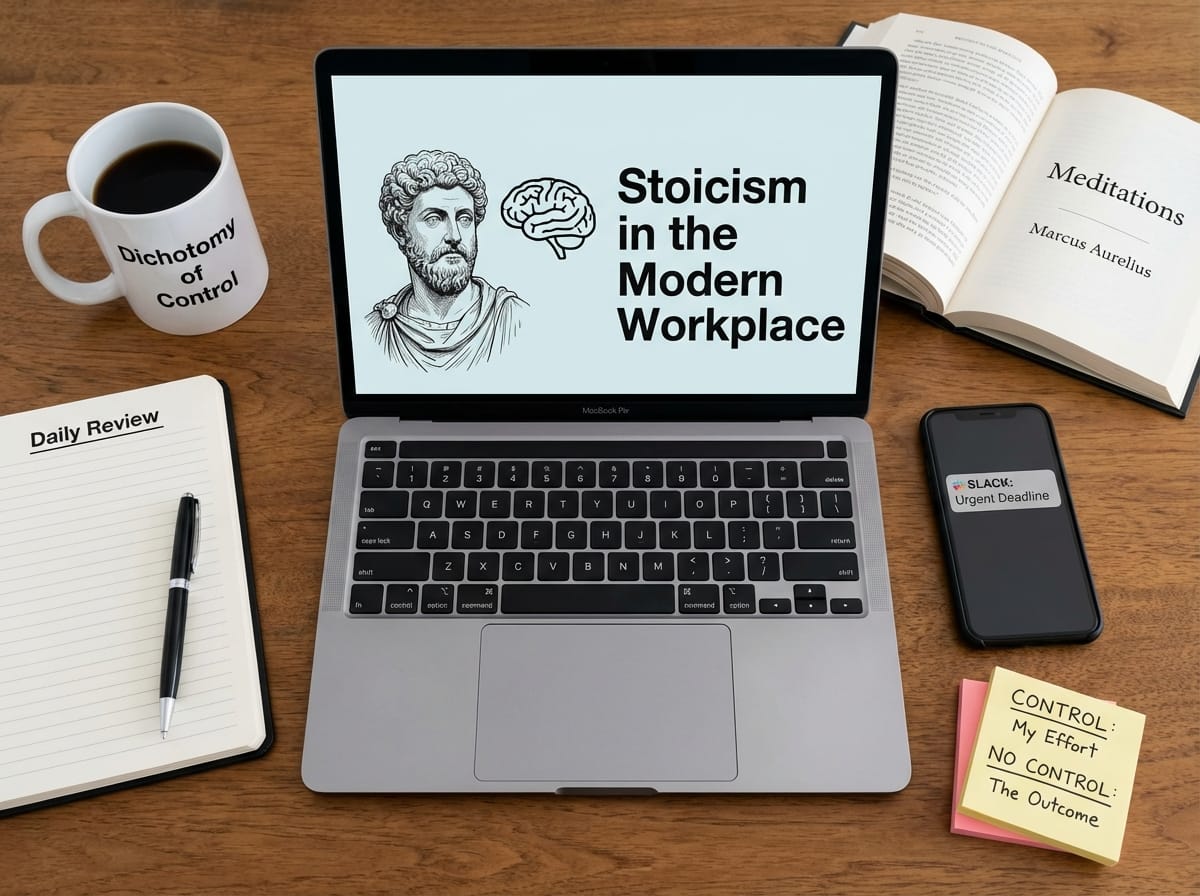
The modern workplace often feels like a battlefield. Between the endless barrage of Slack notifications, urgent deadlines that appear out of nowhere, and the pressure of quarterly goals, it is easy to feel overwhelmed. Interestingly, the best toolkit for navigating this high-tech corporate environment comes from ancient Greece and Rome.
Stoicism is not about suppressing your emotions or becoming a robot. It is an operating system for the mind that helps you remain calm under pressure, make better leadership decisions, and focus your energy where it actually matters. Here is how you can apply Stoic philosophy to survive and thrive in the modern office.
What is Stoicism? (And What It Isn’t)
Before applying it to your next Zoom meeting, we need to clear up a common misconception. Being “Stoic” doesn’t mean having a stiff upper lip or ignoring your feelings. It is a philosophy of personal ethics and logic.
ELI5 (Explain Like I’m 5): Imagine you are playing a video game. You cannot control if the game glitches, if the internet lags, or if the other players are being mean. If you scream at the TV, you lose focus and might lose the game. Stoicism is realizing that while you can’t control the game’s difficulty, you can control how well you play and how you react to the glitches. It teaches you to stay cool so you can play your best.
The Dichotomy of Control: The Ultimate Productivity Hack
The core pillar of Stoicism is the Dichotomy of Control. Epictetus, a famous Stoic teacher, taught that some things are up to us, and some things are not. In a corporate setting, confusing these two categories is the primary source of stress.
What You Can vs. Cannot Influence
To reduce anxiety, you must ruthlessly categorize your work worries:
- Things you control: Your work ethic, the quality of your emails, how you prepare for a presentation, your tone of voice, and your reaction to bad news.
- Things you do not control: The economy, whether a client signs the contract, your boss’s mood, office gossip, or technical failures.
Practical Example: The Lost Client
Imagine you spent weeks working on a pitch for a huge client, but they decided to go with a competitor.
- The Non-Stoic approach: You panic. You blame yourself. You complain to coworkers that the client is “stupid” or the decision was “unfair.” You waste three days being unproductive because you are upset.
- The Stoic approach: You acknowledge the loss. You review your work (which you control) to see if you can improve your skills for next time. You accept that the client’s decision (external) was out of your hands. You immediately pivot to the next task without carrying emotional baggage.
Stoic Leadership: Leading with Reason, Not Emotion
Marcus Aurelius was the Emperor of Rome and the most powerful man on earth, yet he wrote a journal (Meditations) to remind himself to be humble and patient. Modern leaders can learn a lot from his management style.
Managing Reactivity in Communication
In the age of instant messaging, the temptation to fire off an angry reply to a rude email is high. A Stoic leader pauses. Seneca, another Stoic philosopher, wrote extensively on anger, viewing it as a temporary madness.
The Strategy: When you receive upsetting news or critical feedback, take a mandatory “Stoic Pause.” Do not reply immediately. Ask yourself: “Will getting angry help solve this problem, or will it just create a new problem?” usually, the answer is the latter.
Handling Criticism Objectively
When a manager or colleague critiques your work, it hurts the ego. Stoics view criticism as data.
ELI5: If you have spinach in your teeth and someone tells you, do you get mad at them? No, you thank them because they helped you fix a problem. Stoics treat work criticism the same way. If the criticism is true, you fix the “spinach” (the error). If the criticism is false, you ignore it because it’s not about you—it’s about the other person’s perception.
Using “Premeditatio Malorum” to Beat Stress
This Latin phrase means “the premeditation of evils.” It sounds gloomy, but it is actually a powerful technique for project management and anxiety reduction.
How to Use Negative Visualization at Work
Instead of blindly hoping for the best, spend five minutes imagining what could go wrong. This is not pessimism; it is preparation.
Scenario: You are launching a new software feature.
- Visualize the worst: Imagine the server crashes, the marketing email has a typo, and the team is sick on launch day.
- Prepare the defense: Because you visualized this, you now create a backup server plan, you double-check the email copy, and you have a freelancer on standby.
By engaging in this exercise, you remove the shock factor. If things go wrong, you remain calm because you have already mentally rehearsed the scenario.
Actionable Steps to Become a Corporate Stoic
You don’t need to read volumes of ancient texts to start benefiting today. Here is a simple daily routine to integrate Stoicism into your 9-to-5:
1. The Morning Preparation
Before checking your email, take two minutes to remind yourself: “Today I may meet people who are stressed, rude, or ungrateful. I will not let their behavior destroy my inner peace.”
2. The “Is This Essential?” Filter
Marcus Aurelius asked, “Ask yourself at every moment, ‘Is this necessary?'” Use this for meetings and tasks. If a task doesn’t move the needle on your goals (what you control), try to delegate or delete it. This is the ultimate SEO (Search Engine Optimization) for your schedule—ranking only high-value tasks.
3. The Evening Review
At the end of the workday, do a quick retrospective. Do not beat yourself up. simply ask:
- What upset me today?
- Did I lose control of my temper?
- How can I respond better tomorrow?
Conclusion
Stoicism in the modern workplace is about reclaiming your agency. By distinguishing between what you can manage and what you must accept, you become a more effective employee and a more resilient leader. You stop wasting energy on frustration and start channeling it into action. The deadline may be tight, and the wifi may be spotty, but your mind remains your own.
