

If you are thinking about buying a home, you have probably heard a dizzying alphabet soup of mortgage terms. Among the most common—and most misunderstood—are Fannie Mae, Freddie Mac, and Ginnie Mae. While they sound like a trio of friendly neighbors, these three entities are actually massive financial powerhouses that keep the United States housing market running smoothly.
But how do they actually affect you? And what are the strict laws and rules you need to follow as a consumer to secure a mortgage today? In this comprehensive guide, we will break down exactly what these organizations do, explain the consumer laws that protect you, and simplify the home-buying process so you know exactly what to expect.
What Are Fannie Mae, Freddie Mac, and Ginnie Mae?
To understand these three organizations, you first need to understand what happens after you get a mortgage. When you borrow money from a bank to buy a house, the bank rarely holds onto that loan for 30 years. Instead, they sell your mortgage on what is called the “secondary mortgage market.” This frees up the bank’s cash so they can lend money to the next homebuyer.
Fannie, Freddie, and Ginnie are the main buyers and guarantors in this secondary market. Here is how they differ.
Fannie Mae (Federal National Mortgage Association)
Created by the government in 1938 to stimulate the housing market during the Great Depression, Fannie Mae buys mortgages primarily from large, major retail banks (like Chase or Bank of America). By purchasing these loans, they provide banks with a steady stream of cash to keep lending to consumers.
ELI5 (Explain Like I’m 5): Imagine a baker (the big bank) who bakes a giant cake (your mortgage). The baker sells that cake to a massive grocery store chain (Fannie Mae). Now the baker has cash in his pocket right away to buy more flour and sugar to bake cakes for other people.
Freddie Mac (Federal Home Loan Mortgage Corporation)
Freddie Mac was created in 1970 to provide competition for Fannie Mae. They do the exact same thing as Fannie Mae, but with one main difference: Freddie Mac typically buys mortgages from smaller “thrift” banks, credit unions, and smaller community lenders rather than massive national banks.
ELI5: It is the exact same concept as Fannie Mae, but this giant grocery store prefers to buy its cakes from small, local mom-and-pop bakeries instead of massive commercial kitchens.
Ginnie Mae (Government National Mortgage Association)
Unlike Fannie and Freddie, Ginnie Mae does not buy mortgages. Instead, Ginnie Mae acts as an insurance policy for investors who buy government-backed loans. Ginnie Mae guarantees mortgages issued by government agencies, such as the FHA (Federal Housing Administration), VA (Veterans Affairs), and USDA (Department of Agriculture).
ELI5: Ginnie Mae is like a rich uncle who co-signs a promise. He doesn’t buy the cake from the baker. Instead, he looks at the people buying government-sponsored cakes (like veterans or first-time buyers) and tells the investors, “If they don’t pay for their cake, I promise I will pay you out of my own pocket.”
Consumer Laws and Rules for Securing a Mortgage
Because of the financial crash in 2008—which was largely caused by banks giving out bad mortgages that eventually crashed Fannie Mae and Freddie Mac—the U.S. government instituted strict laws to protect both the economy and the consumer. If you are applying for a mortgage today, you and your lender must follow these strict rules.
The Dodd-Frank Act and the Ability-to-Repay (ATR) Rule
Passed in 2010, the Dodd-Frank Wall Street Reform and Consumer Protection Act completely changed how mortgages are approved. The biggest rule to come from this is the Ability-to-Repay (ATR) rule. Lenders are legally required to verify that you have the financial means to pay back the loan.
ELI5: A bank is no longer legally allowed to lend you $1 million if your allowance is only $10 a week. They must look at your piggy bank and your chore money to prove you can afford the monthly payments.
Example: In the early 2000s, you could get a “NINJA” loan (No Income, No Job, no Assets) where lenders just took your word that you could pay. Today, under the ATR rule, lenders must legally demand two years of tax returns, recent pay stubs, W-2s, and bank statements to prove your income.
Truth in Lending Act (TILA) and Real Estate Settlement Procedures Act (RESPA)
Together, these laws form what is known as TRID (TILA-RESPA Integrated Disclosure). The goal of TRID is absolute transparency. Lenders must provide you with clear, easy-to-read documents so you know exactly what your mortgage is going to cost you over time, preventing hidden fees.
- The Loan Estimate: A rule dictating that within 3 days of applying for a mortgage, the lender must give you a document clearly stating your estimated interest rate, monthly payment, and closing costs.
- The Closing Disclosure: A rule dictating that you must receive a final breakdown of all costs at least 3 business days before you sign the final paperwork.
Example: If a lender tells you your closing costs are $5,000, but on the day of closing tries to charge you $10,000 in surprise fees, you are protected by TRID. The 3-day Closing Disclosure rule ensures you have time to review the numbers and walk away if the lender tries to pull a fast one.
The Equal Credit Opportunity Act (ECOA)
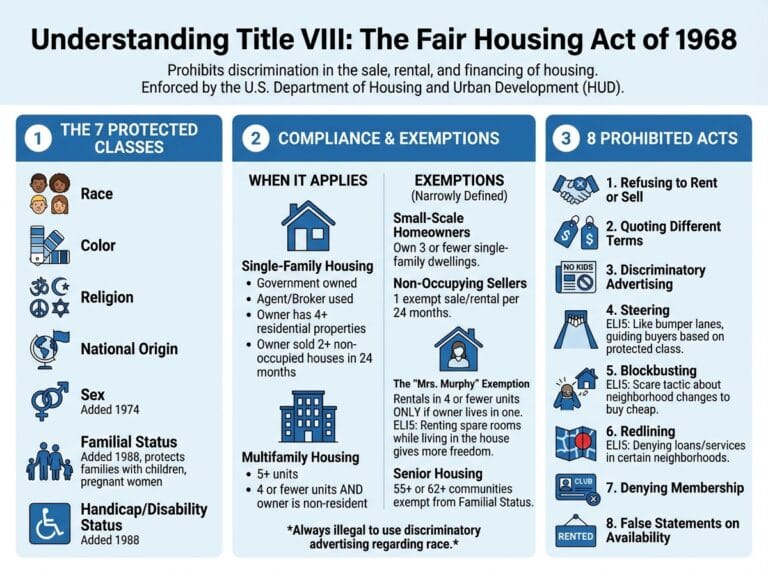
This law ensures a fair playing field for all consumers. The ECOA strictly prohibits lenders from discriminating against a mortgage applicant based on race, color, religion, national origin, sex, marital status, age, or whether they receive public assistance.
ELI5: The bank is only allowed to judge you based on your math (your credit score, your debt, and your income). They are not allowed to judge you based on who you are, where you come from, or what you look like.
Step-by-Step Rules for Getting Approved Today
Because Fannie Mae, Freddie Mac, and Ginnie Mae have strict standards on what types of loans they will support, lenders pass those rules down to you. To secure a mortgage, you must meet specific consumer criteria:
- Credit Score Minimums: To get a conventional loan (backed by Fannie or Freddie), consumers generally need a minimum credit score of 620. For an FHA loan (backed by Ginnie Mae), you can go as low as 580.
- Debt-to-Income (DTI) Ratio Rules: Consumer laws require lenders to ensure your total monthly debts (car payments, student loans, plus the new mortgage) do not exceed a certain percentage of your gross monthly income. The rule of thumb is a maximum DTI of 43%, though exceptions exist up to 50% with strong credit.
- Down Payment Regulations: While you don’t need 20% down, consumer rules dictate minimums. Fannie/Freddie allow as little as 3% down for first-time buyers. Ginnie Mae-backed FHA loans require 3.5% down, and VA loans require 0% down.
- Private Mortgage Insurance (PMI): If you put down less than 20% on a Fannie/Freddie conventional loan, the rules state you must pay for PMI to protect the lender.
The Bottom Line on Securing Your Mortgage
Navigating the world of home buying is much easier when you understand the players and the rules of the game. Fannie Mae, Freddie Mac, and Ginnie Mae are the engines working behind the scenes to make sure banks have the money to lend to you. Meanwhile, consumer protection laws like the Dodd-Frank Act and TRID are your shield, ensuring that lenders treat you fairly, verify your ability to pay, and never blindside you with hidden fees.
By keeping your credit score healthy, keeping your debt low, and understanding your rights under federal mortgage laws, you will be in the perfect position to secure a mortgage and buy the home of your dreams.