
Understanding the Different Types of Value in Real Estate
When you hear the question, “What is this property worth?”, the answer isn’t always a simple number. In the world of real estate, property valuation is a complex topic. The “value” of a property changes depending on who is asking and why they are asking. A tax assessor, an insurance agent, a homebuyer, and a real estate investor will all look at the exact same piece of real estate and arrive at entirely different numbers.
To help you navigate the real estate market, we have broken down the seven different types of value in real estate. Whether you are buying your first home or building an investment portfolio, understanding these definitions is crucial for your financial success.
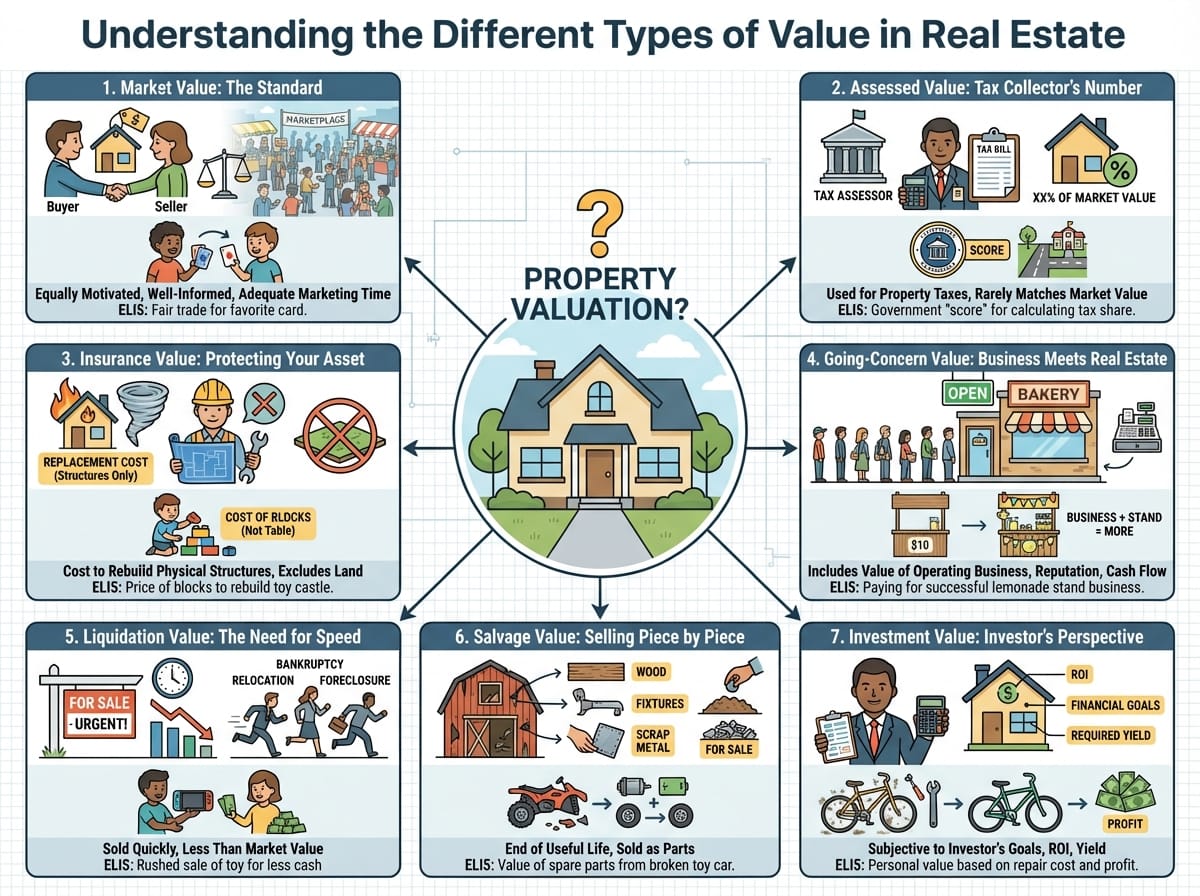
1. Market Value: The Standard of Real Estate
When most people talk about what a house is worth, they are referring to the Market Value. By definition, market value is the most probable price a property will bring in an open, competitive market. It is the highest price a willing buyer would pay, and the lowest price a willing seller would accept.
Assumptions Associated with Market Value
For a transaction to truly reflect market value, several specific assumptions must be met:
- Equally Motivated Parties: Both the buyer and the seller are motivated to close the deal, but neither is under extreme pressure or duress (like facing a sudden foreclosure).
- Well-Informed Parties: Both parties are acting in their own best interest and are well-informed about the property’s condition and the current market.
- Adequate Marketing Time: A reasonable and adequate attempt was made to market the property over a normal time period. It wasn’t hidden or sold overnight.
ELI5 (Explain Like I’m 5): Market Value
Imagine you are trading your favorite trading card at school. Market value is the exact number of standard cards your friend is happy to trade, and you are happy to accept, when neither of you is rushing and everyone in the cafeteria had a chance to make an offer.
2. Assessed Value: The Tax Collector’s Number
The Assessed Value is a valuation placed on a property by a public tax assessor for the sole purpose of collecting property taxes. Local governments use this number to calculate your annual tax bill.
It is important to note that the assessed value rarely matches the market value. In many municipalities, the assessed value is only a certain percentage of the actual market value.
ELI5: Assessed Value
Think of the assessed value as a “score” the government gives your house. They don’t want to buy your house; they just use this score to figure out your share of the bill for fixing local roads and funding schools.
3. Insurance Value: Protecting Your Asset
If disaster strikes, you need to know your Insurance Value. This value is calculated to determine the replacement cost of the property. It focuses strictly on how much it would cost in materials and labor to rebuild the physical structures on the land.
Insurance value excludes the value of the land itself because, even if a house burns down, the land will still be there. Therefore, insurance value is often lower than market value.
ELI5: Insurance Value
If a tornado blows your toy castle away, the insurance value is simply the cost of buying the exact same plastic blocks to rebuild it. It doesn’t include the value of the table the castle was sitting on.
4. Going-Concern Value: Where Business Meets Real Estate
Going-Concern Value applies primarily to commercial real estate. It represents the value of a property when an operating business is attached to it. The value of a business may be less than, equal to, or greater than the value of the real estate itself, largely based on how reputation, goodwill, and cash flow affect the overall value.
Example: A standalone building might have a market value of $500,000. However, if that building is currently operating as a highly profitable, locally beloved bakery, a buyer might pay $800,000 for the building and the business. The extra $300,000 reflects the going-concern value.
ELI5: Going-Concern Value
A plain lemonade stand made of wood is worth $10. But if that exact stand is famous in the neighborhood and makes $50 a day because everyone loves the secret recipe, the whole setup is worth much more than just the $10 wood. People are paying for the successful business, not just the boards.
5. Liquidation Value: The Need for Speed
Liquidation Value comes into play when money is needed quickly. Under these circumstances, a property is usually sold at a value significantly less than it would fetch within a normal marketing timeframe. This often happens during bankruptcies, urgent relocations, or foreclosures.
ELI5: Liquidation Value
Imagine you are moving to a new country tomorrow and you can’t take your $500 video game console with you. Because you need cash today and don’t have time to wait for the perfect buyer, you sell it to your neighbor for $100. That $100 is the liquidation value.
6. Salvage Value: Selling Piece by Piece
When a building is at the end of its useful life, or has been severely damaged, it holds a Salvage Value. This is the estimated value a property has when it is sold piece by piece rather than as a whole unit.
Example: An old barn might be falling down and worthless as a structure. However, the weathered barn wood, vintage fixtures, and scrap metal inside can be dismantled and sold individually to craftsmen and scrap yards.
ELI5: Salvage Value
If your remote-control car breaks and can’t drive anymore, the whole car seems worthless. But you can still take out the battery, the motor, and the wheels to sell to your friends who need spare parts. The money you make from the parts is the salvage value.
7. Investment Value: The Investor’s Perspective
Finally, we have Investment Value. This is a highly subjective number used by real estate investors. Investors temper the value that a property seems to have by subtracting how much money will need to be invested in order to obtain a desirable return on their investment (ROI).
While market value looks at what the general public would pay, investment value is specific to an individual investor’s financial goals, tax situation, and required yield.
ELI5: Investment Value
You see a messy, dirty bicycle for sale for $50. You know that if it was clean and fixed, you could sell it for $100. However, it will cost you $30 in parts and soap to fix it. To make a good profit for your hard work, you decide you can only afford to pay $40 for the dirty bike. To you, the investment value is $40, even if the seller is asking for $50.