
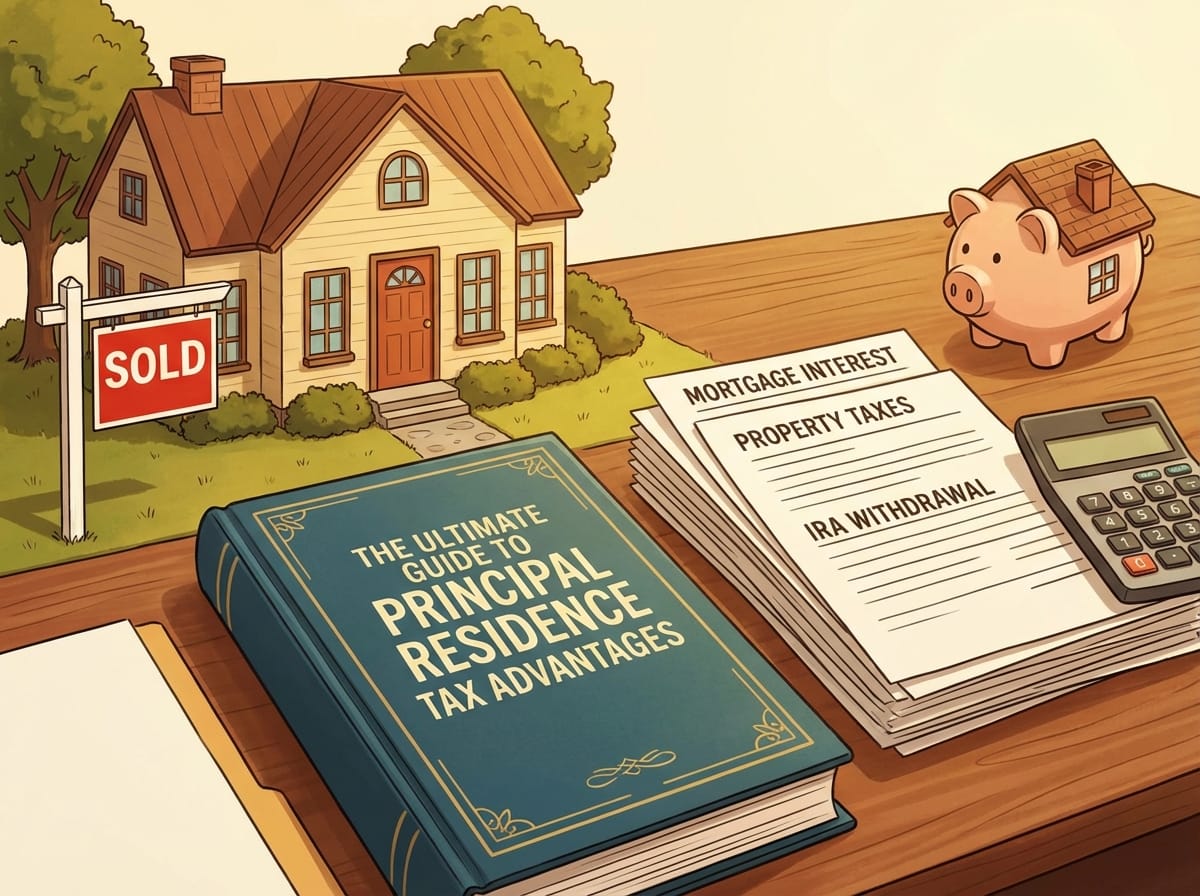
The Ultimate Guide to Principal Residence Tax Advantages
Buying a home is the American dream, but did you know it also serves as a powerful financial tool? Beyond building equity and having a place to call your own, owning real estate comes with highly lucrative tax advantages. If you know how to navigate the tax code, your principal residence can save you thousands of dollars come tax season.
In this guide, we will break down the top tax advantages of homeownership, complete with simple explanations and real-world examples to help you maximize your tax returns.
Deducting Your Ongoing Home Expenses
One of the biggest perks of owning a home is the ability to write off some of your largest annual expenses. The IRS allows you to deduct specific costs associated with both your principal residence and a second home.
The Mortgage Interest Deduction
Property owners can claim a mortgage interest deduction on their taxes. This applies to the interest paid on the loan for your principal residence, and the great news is that it also applies to a second home!
ELI5 (Explain Like I’m 5): Imagine you borrowed a big bucket of apples (money) from a farmer (the bank) to buy a treehouse. Every year, you have to give the farmer a few extra apples as a “thank you” for the loan. The government says, “Because you bought a treehouse, you don’t have to count those extra apples when we calculate your taxes.”
Example: Let’s say you paid $12,000 in mortgage interest over the course of the year. If you itemize your deductions, you can deduct that entire $12,000 from your taxable income, lowering your overall tax bill.
Deduction of Property Taxes
Just like mortgage interest, you are allowed to deduct the property taxes you pay on your principal residence. If you own a vacation home or a second home, the property taxes paid on that property are deductible as well.
Leveraging Your Retirement for a Down Payment
Saving for a down payment is often the biggest hurdle for new buyers. Fortunately, the IRS provides a special loophole for those who have been saving in an Individual Retirement Account (IRA).
IRA Withdrawal for First-Time Home Buyers
A first-time homebuyer can withdraw up to $10,000 from an IRA without paying the standard 10% early withdrawal penalty, provided the funds are used as a down payment on a home.
ELI5: Normally, if you break open your retirement piggy bank before you turn 59 and a half, the government hits you with a heavy fine. However, the government gives you a “get out of jail free” card if you are using that money to buy your very first home, waiving the fine up to $10,000.
Example: Sarah is 30 years old and wants to buy her first condo. She has $25,000 in her traditional IRA. She takes out $10,000 to cover her down payment. While she still has to pay regular income tax on that money, she completely avoids the $1,000 early withdrawal penalty.
Tax-Free Profits: Exclusion of Gain from Sale
Perhaps the most powerful tax advantage of owning a principal residence comes when it is time to sell. If your home has gone up in value, you get to keep a massive portion of the profit completely tax-free.
The Capital Gains Exclusion Rules
When an individual sells a primary residence, they do not have to pay capital gains taxes on any profit up to $250,000. For a married couple filing jointly, that exclusion doubles to a staggering $500,000. To qualify, you must have lived in the property as your primary residence for two out of the five years immediately preceding the sale.
ELI5: If you buy a rare comic book for $10 and sell it later for $100, the government wants a cut of your $90 profit. But if you buy a house to live in and sell it for a profit, the government lets you keep all the profit for yourself, as long as the profit isn’t over half a million dollars for a married couple!
Example: John and Mary bought their home four years ago for $300,000. They lived in it for three years, then rented it out for one year. They just sold the house for $700,000, making a $400,000 profit. Because they lived in it for at least two of the last five years, and their profit is under $500,000, they owe absolutely $0 in capital gains taxes on that $400,000 profit.
Maximizing Loan and Refinance Deductions
Homeownership comes with various financing strategies, like tapping into home equity or refinancing for a better rate. These financial moves also come with specific tax benefits.
Home Equity Loan Interest Deductions
If you take out a home equity loan, the interest you pay on that loan is tax-deductible for the year the interest is paid, for loan amounts up to $100,000. (Note: To qualify for this deduction under current tax laws, the funds from the home equity loan must be used to buy, build, or substantially improve the home that secures the loan.)
Example: You take out a $50,000 home equity loan to put a new roof on your house and renovate the kitchen. Because you used the money to improve the home, the interest you pay on that $50,000 loan is fully deductible.
Deducting Discount Points vs. Refinance Points
When you get a mortgage, you might pay “points” to lower your interest rate. How the IRS treats these points depends on whether you are buying a home or refinancing an existing loan.
- Discount Points on a New Home: Discount points are actually prepaid interest on your mortgage loan. Because of this, they can be taken as a tax deduction in the year you buy the home.
- Refinance Points: If you pay points to refinance your existing mortgage, you cannot deduct them all at once. Instead, refinance points must be deducted gradually over the life of the loan.
ELI5: Points are like paying a fee upfront to make your monthly bills cheaper forever. If you pay this fee when you first buy the house, the IRS lets you take the whole tax break right away. If you pay the fee later just to change your loan (refinancing), the IRS makes you chop up that tax break into tiny pieces and take one piece every year until the loan is paid off.