
Understanding Title VIII of the Civil Rights Act of 1968: The Fair Housing Act
The Civil Rights Act of 1968, commonly referred to as the Fair Housing Act (Title VIII), is a landmark piece of legislation in the United States. It significantly expanded upon the Civil Rights Act of 1964 by strictly prohibiting discrimination in the sale, rental, and financing of housing. Today, this vital law is enforced by the United States Department of Housing and Urban Development (HUD).
Whether you are buying a home, signing a lease, applying for a mortgage, or utilizing real estate brokerage services, the Fair Housing Act ensures that everyone has an equal opportunity to secure housing without prejudice.
The 7 Protected Classes
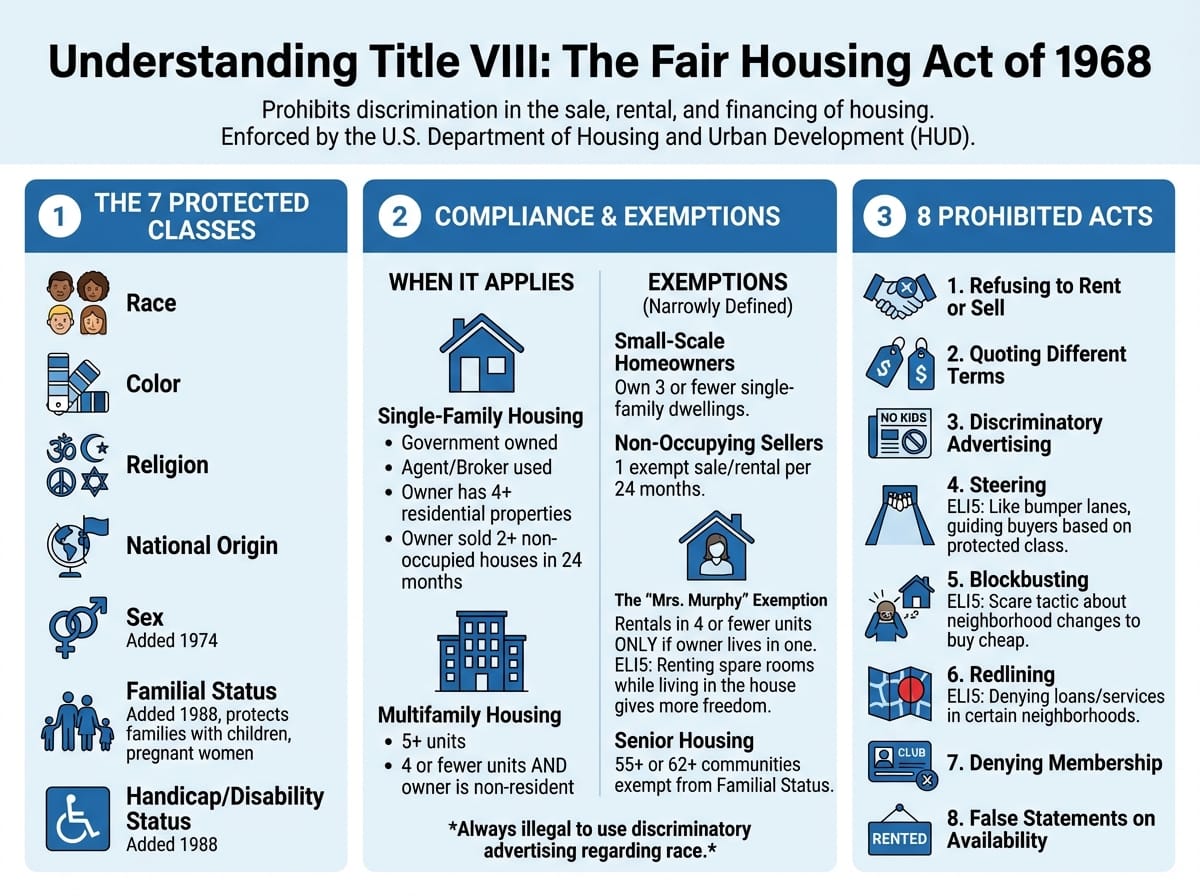
Under Title VIII, it is entirely illegal to discriminate against anyone based on specific protected characteristics. The original act protected four classes, and subsequent amendments have expanded these protections to seven:
- Race
- Color
- Religion
- National Origin
- Sex (Added by the 1974 Amendment)
- Familial Status (Added by the 1988 Amendments – protects families with children under 18 and pregnant women)
- Handicap/Disability Status (Added by the 1988 Amendments)
When Does the Fair Housing Act Apply?
The law covers the vast majority of housing in the United States. However, the specific rules regarding compliance depend on whether the property is a single-family home or a multi-family dwelling.
Single-Family Housing Compliance
A single-family home must comply with the Fair Housing Act if any of the following conditions are met:
- The housing is owned by the government.
- The housing is privately owned, but a licensed real estate agent or broker is employed to sell or rent it.
- The property is owned by an individual who owns a total of four or more residential properties.
- The owner has sold two or more houses (that they did not personally occupy) within the past 24 months.
Multifamily and Unit Housing Compliance
For buildings with multiple units (like apartment complexes or duplexes), the Fair Housing Act applies if:
- The building contains five (5) or more units.
- The building contains four (4) or fewer units AND the owner does not live in one of the units.
Exemptions: When is Real Estate Exempt from the Fair Housing Act?
While the law is broad, there are a few very specific, narrow exemptions where a property owner does not have to comply with certain parts of the Fair Housing Act. (Note: Even if exempt, it is always illegal to use discriminatory advertising regarding race.)
- Small-Scale Homeowners: If the seller owns three or fewer single-family dwellings.
- Non-Occupying Sellers: If the seller does not live in the house and was not the most recent resident, they are allowed one exempt sale or rental within a 24-month period.
- The “Mrs. Murphy” Exemption: Rentals in multifamily dwellings with four or fewer family units, only if the owner lives in one of the units.
- Senior Housing: Legally designated 55-and-up or 62-and-up housing communities are exempt from the Familial Status protection (meaning they are legally allowed to exclude families with children).
ELI5 (Explain Like I’m 5): The “Mrs. Murphy” Exemption
Imagine you have a large house and you decide to rent out three of your spare bedrooms to other people, but you still live in the house too. Because you are sharing your personal living space (your own roof), the law gives you a little more freedom to choose who you live with. But if you move out and rent the whole house, you have to follow all the rules!
8 Prohibited Acts Under the Fair Housing Act
To ensure fair treatment, the law specifically outlaws eight practices in the real estate and lending industries. Let’s break them down, including ELI5 explanations for the more complex industry terms.
1. Refusing to Rent or Sell
A landlord or seller cannot refuse to negotiate, sell, or rent a property to someone purely because they belong to one of the seven protected classes.
2. Quoting Different Terms
Everyone must be offered the same terms and conditions. For example, a landlord cannot require a $500 security deposit from a single person but demand a $1,000 security deposit from a family with children.
3. Discriminatory Advertising
It is illegal to print or publish housing advertisements that indicate a preference or limitation based on protected classes. For example, an ad cannot say “No children allowed” or “Christian neighborhood.”
4. Steering
ELI5: Think of steering like bumper lanes at a bowling alley. A real estate agent acts like the bumpers, secretly “bumping” a buyer away from certain neighborhoods and toward others based on their race or religion, instead of letting the buyer choose freely.
Example: An agent tells a Hispanic family, “You probably wouldn’t feel comfortable in this neighborhood, let me show you houses on the east side where your community is.” This is highly illegal.
5. Blockbusting
ELI5: Blockbusting is a scare tactic. It’s when someone tries to scare a homeowner into selling their house for very cheap by telling them that people of a different race or religion are moving into the neighborhood and ruining property values.
Example: A real estate investor sends flyers to a white neighborhood saying, “Minorities are moving in, sell your house to me now before it loses all its value!” The investor then resells the houses at a premium. This panic-peddling is banned.
6. Redlining
ELI5: Imagine taking a red marker and drawing a circle around certain neighborhoods on a map. Redlining is when a bank or insurance company says, “We will not give loans to anyone buying a house inside this red circle,” usually because those neighborhoods have a high minority population.
Example: A well-qualified buyer applies for a mortgage but is denied simply because the house they want to buy is located in a predominantly Black neighborhood. The Fair Housing Act makes this geographic discrimination illegal.
7. Denying Membership in Brokerage Services
Real estate professionals cannot be denied access to or membership in Multiple Listing Services (MLS) or real estate broker’s organizations based on their race, sex, religion, or other protected status.
8. False Statements Regarding Availability
It is illegal to lie about a property being unavailable when it actually is. For instance, a property manager cannot tell a disabled applicant that an apartment was just rented, and then immediately show that same apartment to an applicant without a disability.