

Are you looking for a way to generate a steady, passive income stream using your digital marketing skills? Enter the Rank and Rent model. This powerful local SEO strategy allows you to build valuable digital assets that local businesses are eager to pay for, month after month. In this guide, we’ll break down exactly what Rank and Rent is, how it works, and why it might be the perfect business model for you.
What is the Rank and Rent Model? An ELI5 Guide
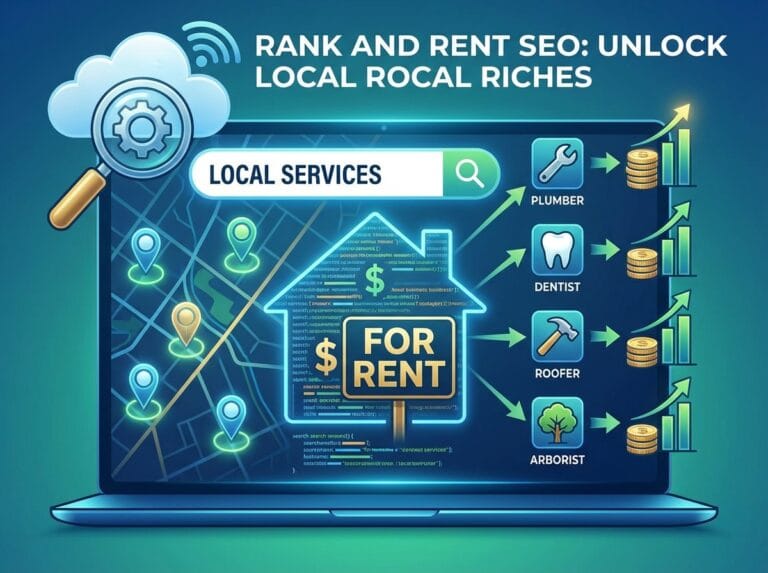
Imagine you buy a piece of land in a great location and build a beautiful storefront on it. You don’t want to run a store yourself, so you find a local business owner who does, and you rent the storefront to them for a monthly fee. You own the property; they get the benefit of a prime location without the hassle of building it.
The Rank and Rent model is the digital version of this. You:
- Choose a local service (like “plumbing” or “roofing”) in a specific city.
- Build a simple website (your “digital storefront”).
- Use Search Engine Optimization (SEO) to get that website to the top of Google’s search results for terms like “plumber in Austin” (making it “prime digital real estate”).
- Find a local plumber who wants more customers and “rent” the website to them. The phone calls and contact form submissions (the leads) generated by your website go directly to their business.
In exchange, they pay you a flat monthly fee. You own the asset (the website), and they get a steady flow of exclusive leads. It’s a win-win.
How Rank and Rent Works: A 4-Step Blueprint
The process might sound complex, but it can be broken down into four manageable steps. Here’s a high-level overview of the strategy from start to finish.
Step 1: Choose Your Niche and Location
This is the most critical step. You need to find a service niche and a city with the right balance of demand and competition. You’re looking for a service that has a high value per customer (think emergency plumbers, lawyers, or home remodelers) in a city that isn’t already dominated by marketing giants.
Things to look for:
- High-Ticket Services: A single customer is worth a lot of money (e.g., a new roof costs thousands, so a roofing company will pay well for a lead).
- “Need-Now” Services: Think of emergency services people search for when they have an urgent problem, like “24/7 electrician” or “emergency water damage repair.”
- Manageable Competition: Look at the top results on Google for your target keyword. Are they all massive companies with huge budgets, or are they small local businesses with weak websites? The latter is what you want.
Step 2: Build Your Digital Asset
Your “digital asset” is your website. The good news is that these websites don’t need to be fancy. They just need to be professional, fast, and optimized to convert visitors into leads. You’ll also need a unique phone number to track the calls generated by the site.
Your website should include:
- A professional, mobile-friendly design.
- A clear call-to-action (CTA) with a clickable phone number.
- A simple contact form.
- Several pages of content about the services offered (e.g., “Residential Roofing,” “Commercial Roofing,” “Roof Repair”).
- A unique, trackable phone number (you can get one from services like CallRail or Twilio).
Step 3: Rank the Asset with Local SEO
This is the “Rank” part of the equation. Your goal is to convince Google that your website is the most relevant and authoritative result for your chosen keywords. This involves a combination of on-page and off-page local SEO tactics.
ELI5 for SEO: Think of Google as a librarian. On-page SEO is like making sure your book has a clear title, a table of contents, and is well-written. Off-page SEO is like getting other respected authors to recommend your book. You need both to become a bestseller (or a top-ranking site).
Key SEO tasks include:
- Keyword Research: Finding the exact phrases customers are typing into Google.
- On-Page SEO: Optimizing your website’s titles, headings, and content with your target keywords.
- Google Business Profile (GBP): Creating and optimizing a GBP listing for your brand. This is crucial for showing up in the local map pack.
- Citations: Getting your business name, address, and phone number listed in relevant online directories like Yelp and Yellow Pages.
- Backlinks: Getting other relevant, local websites to link back to your site.
Step 4: Rent Out Your Asset
Once your website is ranking on the first page of Google and generating phone calls and form fills, it’s time to find a “tenant.” You’ll reach out to local businesses in your niche who could benefit from more customers.
Your pitch is simple: “I have a website that is generating X number of exclusive customer leads for [your service] in [your city] each month. I am looking for one partner to take these leads. Would you be interested in a free trial?”
By offering a free trial of the leads, you prove your asset’s value upfront, making it an easy decision for the business owner to start paying you a monthly rental fee.
Why Is Rank and Rent So Powerful?
This isn’t just another online business model; it has several key advantages that make it incredibly appealing, especially for those seeking financial freedom and control.
You Own the Asset
Unlike working for a client, you own the website, the ranking, and the entire lead-generating system. If a business owner decides to stop paying you, you don’t lose your work. You simply find another company and forward the leads to them. You are always in control.
It Creates Passive Income
Once a site is built and ranked, it requires very little maintenance. The initial SEO work is the hardest part. After that, you’re mostly just cashing a check each month. This frees up your time to build your next digital asset, scaling your income.
It’s Highly Scalable
The process is repeatable. Once you’ve successfully ranked and rented one website, you can do it again and again in different niches and cities. Each new site is another income stream added to your portfolio, with the potential to build a true digital real estate empire.