
Understanding the Principles of Value in Real Estate
Whether you are buying, selling, or appraising a property, understanding how real estate is valued is crucial. Property value isn’t just a random number pulled from thin air; it is calculated using specific, time-tested rules known as the principles of value. These economic guidelines help appraisers and investors determine the most accurate market value of a piece of real estate.
While there are several principles used in property valuation, four of the most fundamental rules include Substitution, Highest and Best Use, Increasing and Decreasing Returns, and Conformity. Let’s break down each principle, explore real-world examples, and simplify them so anyone can understand.
Principle 1: Substitution
The principle of substitution is the foundational rule behind the market data (or sales comparison) approach to real estate appraisal. It states that a rational, informed buyer will not pay more for a property than the cost of acquiring an equally desirable and functional substitute property.
How Substitution Works in the Market
When multiple similar properties are available, the one with the lowest price will generally attract the highest demand. This principle prevents property owners from severely overpricing their homes, as buyers will simply substitute the overpriced home for a more affordable, similar option.
ELI5: The Principle of Substitution
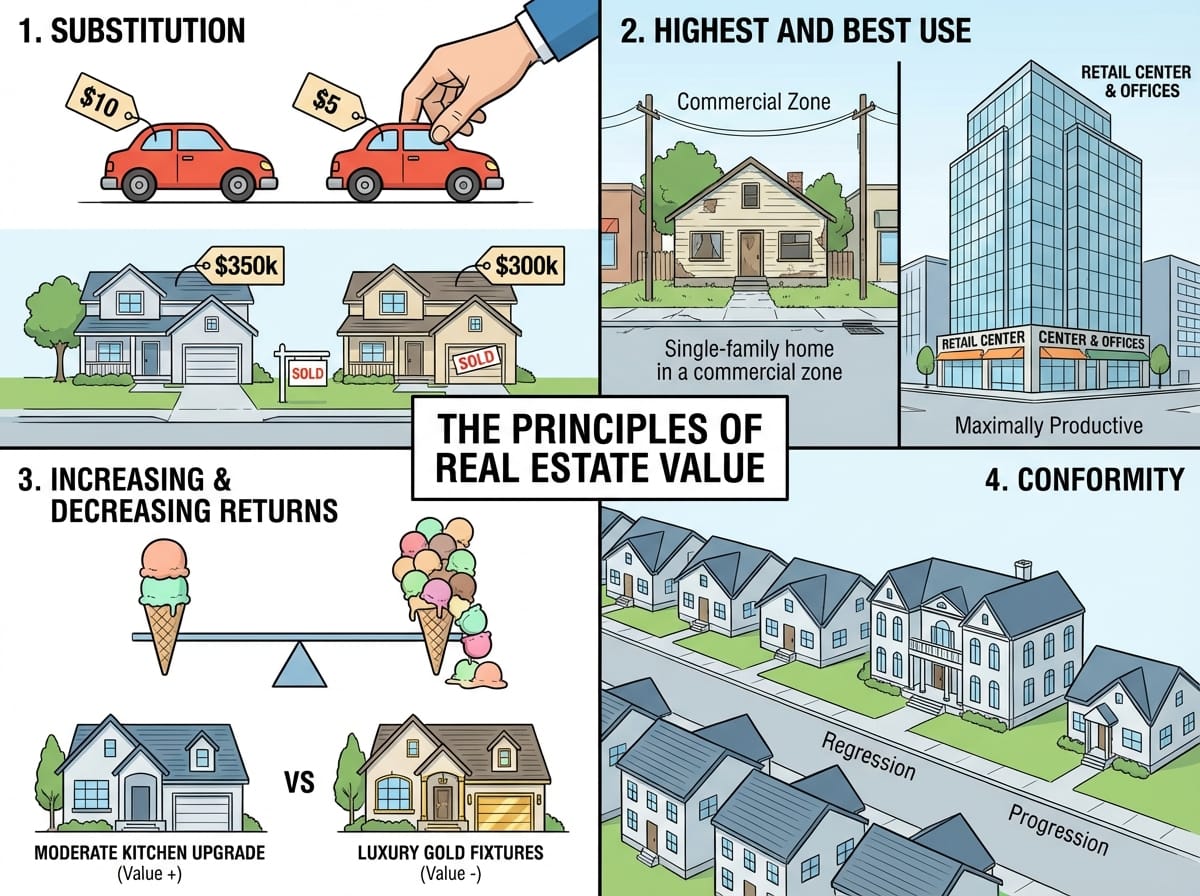
ELI5 (Explain Like I’m 5): Imagine you want to buy a brand new red toy car. Store A is selling it for $10, and Store B right across the street is selling the exact same red toy car for $5. You are going to buy it from Store B because you won’t pay $10 when you can get the exact same thing for $5.
Real Estate Example: If two identical three-bedroom, two-bathroom houses are for sale in the exact same neighborhood, and one is listed at $300,000 while the other is listed at $350,000, buyers will naturally put offers on the $300,000 house. The $350,000 house will not sell until the price is lowered to match its substitute.
Principle 2: Highest and Best Use
The principle of highest and best use dictates that a property’s maximum value is realized when it is put to the most profitable use that is legally permissible, physically possible, and financially feasible.
Determining the Most Profitable Use
Appraisers look at a property not just for what it is currently being used for, but for what it could be used for. To pass the test for highest and best use, the proposed use must meet four criteria:
- Legally permissible: Does zoning allow it?
- Physically possible: Is the land large enough and stable enough?
- Financially feasible: Will it generate an income or value greater than the cost to build it?
- Maximally productive: Which use yields the highest net return?
ELI5: Highest and Best Use
ELI5: Imagine you have a giant, empty cardboard box. You could use it to store old junk, or you could use it to build an amazing spaceship fort and charge your friends a piece of candy to play in it. The spaceship fort is the “highest and best use” because it brings you the biggest reward.
Real Estate Example: You own a small, rundown single-family home on a large plot of land located in the middle of a bustling, expanding commercial downtown district. The property’s highest and best use is no longer a residential home. Instead, knocking the house down and building a commercial retail center or a paid parking lot would be the highest and best use, drastically increasing the land’s value.
Principle 3: Increasing and Decreasing Returns
Also known as the law of diminishing returns, this principle applies to property improvements. It states that adding capital improvements to a piece of real estate will increase its value, but only up to a certain point. Eventually, the cost of the improvements will exceed the value they add to the property.
The Danger of Over-Improving
Investors and homeowners must be careful when renovating. Increasing returns happen when a $10,000 kitchen remodel adds $15,000 to the home’s value. Decreasing returns occur when a homeowner continues to pour money into upgrades that buyers in that specific market are not willing to pay for.
ELI5: Increasing and Decreasing Returns
ELI5: Think about an ice cream cone. Adding one scoop of ice cream makes it delicious and much better. Adding a second scoop makes it even better! But if you try to add twenty scoops, the ice cream becomes too heavy, falls on the ground, and ruins the cone. More is only better up to a certain point.
Real Estate Example: You live in a working-class neighborhood where the average home price is $200,000. You decide to spend $100,000 adding a luxury swimming pool, imported marble floors, and gold-plated fixtures. When you try to sell, you list the house for $300,000. However, buyers shopping in a $200,000 neighborhood cannot afford a $300,000 home. You will likely only get $220,000 for it, meaning you lost money on those extreme upgrades due to decreasing returns.
Principle 4: Conformity
The principle of conformity states that a property reaches its maximum potential value when its design, size, age, and style are in harmony with the surrounding neighborhood. When properties conform to the standards of their local area, property values remain stable and highly predictable.
Progression and Regression
Conformity introduces two sub-principles:
- Progression: The value of a lesser property is artificially increased by being located among superior, more expensive properties.
- Regression: The value of a superior property is dragged down by being located among lower-quality, less expensive properties.
ELI5: The Principle of Conformity
ELI5: Imagine a school where everyone wears a blue uniform. If you show up wearing a giant, sparkly clown suit, you are going to stand out in a bad way, and no one will want to sit with you. Things fit in and work best when they match their surroundings.
Real Estate Example: A developer builds a massive 6,000-square-foot, three-story luxury mansion in a neighborhood made up entirely of 1,500-square-foot, single-story starter homes. Due to the principle of regression, the giant mansion will not reach its true market value because the surrounding smaller homes drag its value down. Buyers looking for a massive luxury mansion want to live in a neighborhood with other luxury mansions, not starter homes.