
The Florida real estate market is one of the most dynamic in the country. Whether you are looking to start a new career helping families find their dream homes, or you are a real estate investor looking to maximize your profit margins, obtaining a license is the first step. However, navigating the bureaucratic requirements can feel overwhelming.
This guide breaks down exactly what is required to become a licensed Real Estate Sales Associate in Florida, how to navigate the testing process, and specifically how investors can find the right brokerage to support their business goals.
1. The Basic Pre-Requisites: Before You Start
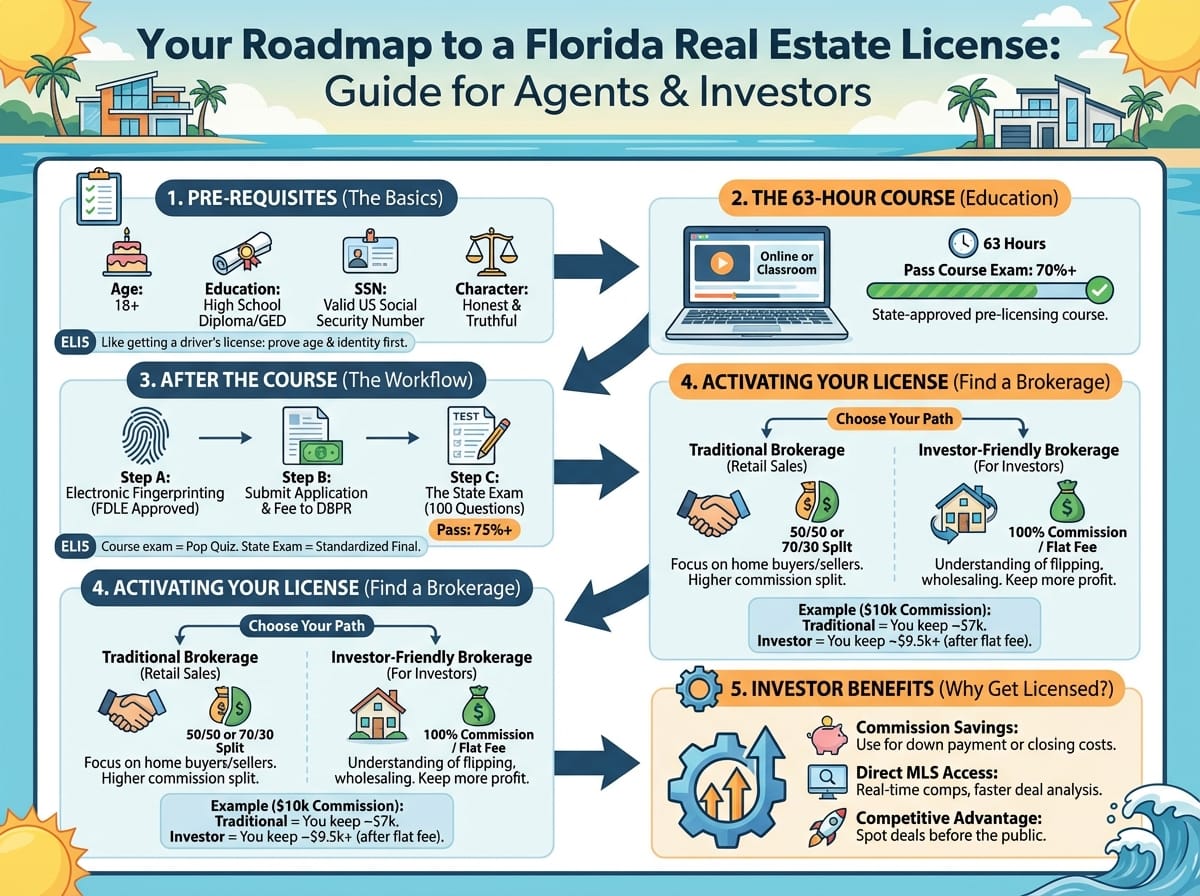
Before you sign up for a class or start studying, you need to ensure you meet the minimum eligibility requirements set by the state. The Florida Department of Business and Professional Regulation (DBPR) requires the following:
- Age: You must be at least 18 years old.
- Education: You must hold a high school diploma or its equivalent (GED).
- Social Security Number: You must possess a valid US Social Security number.
- Character: You must be honest, truthful, and of good moral character. You will be required to disclose criminal convictions.
ELI5 (Explain Like I’m 5): Think of this like getting a driver’s license. Before you can even take the driving test, you have to be old enough and prove who you are. The state just wants to make sure you are a legal adult with a basic education before trusting you with other people’s money and property.
2. The 63-Hour Pre-Licensing Course
Once you meet the basics, the next step is education. Florida requires all applicants to complete a state-approved 63-hour pre-licensing course.
The good news is that you do not need to sit in a physical classroom for weeks. Most people today choose to take these courses online. Online real estate schools are very affordable (often ranging between $100 and $300) and allow you to work at your own pace.
Passing the Course Exam
At the end of your 63 hours, you must pass the course exam with a score of at least 70%. Note that this is not the state exam yet; it is just the final test for the school to prove you learned the material.
3. What to Do After You Pass Your Course
Many new agents get confused about what happens between finishing the school and getting the actual license. Here is the step-by-step workflow:
Step A: Electronic Fingerprinting
You must have your fingerprints taken by a Livescan vendor approved by the Florida Department of Law Enforcement (FDLE). This is for your background check. The state needs to ensure you don’t have a history of financial crimes or fraud.
Step B: Submit Your Application to the DBPR
You must submit a frantic application to the DBPR. You can do this online or by mail. You will pay an application fee (usually around $80-$90). Once the state processes your application and reviews your background check, they will send you an authorization to test.
Step C: The State Exam
Once approved, you will schedule your exam with Pearson VUE. The exam consists of 100 multiple-choice questions. To pass, you need a score of 75% or higher.
ELI5: The course exam is like a pop quiz from your teacher. The State Exam is like the SATs or the final standardized test. You have to pass the teacher’s quiz to qualify for the big standardized test.
4. Activating Your License: Finding a Brokerage
Congratulations! You passed the state exam. However, you cannot practice real estate yet. Your license will be issued with a status of “Inactive.” To make it “Active,” you must place your license with a licensed Real Estate Broker.
In Florida, a Sales Associate (you) must work under the supervision of a Broker. You cannot work independently.
Choosing a Brokerage for Real Estate Investors
If you are getting your license primarily to invest in real estate (flipping, wholesaling, or buying rentals), you should look for an “Investor-Friendly” Brokerage. Traditional brokerages (like the big-name franchises) usually focus on retail sales—helping regular people buy and sell homes to live in.
Here is why the distinction matters:
- Commission Structure: Traditional brokerages often take a 50/50 or 70/30 split of your commission. Investor-friendly brokerages often offer “100% Commission” models or flat-fee transaction fees. This saves you thousands of dollars when you are buying or selling your own properties.
- Understanding the Business: An investor-friendly broker understands creative financing, off-market deals, and wholesaling. A traditional broker might frown upon these practices or not understand the legalities involved.
Example: Imagine you flip a house and the commission is $10,000.
Traditional Broker: They keep $3,000, you keep $7,000.
Investor Broker: You pay a $495 flat fee, you keep $9,505.
5. Why Investors Should Get Licensed
While it takes time and effort to pass the exam, the benefits of holding a real estate license as an investor are substantial. The most obvious benefit is commission savings. When you buy a property, you can represent yourself and apply your commission toward the down payment or closing costs. When you sell a flip, you list it yourself and avoid paying a listing agent fee.
Beyond the money, you gain direct access to the MLS (Multiple Listing Service). This gives you real-time data on comparables (comps) and new listings before the general public sees them on third-party websites. Having MLS access allows you to analyze deals faster and with greater accuracy, giving you a distinct competitive advantage in the Florida market.