

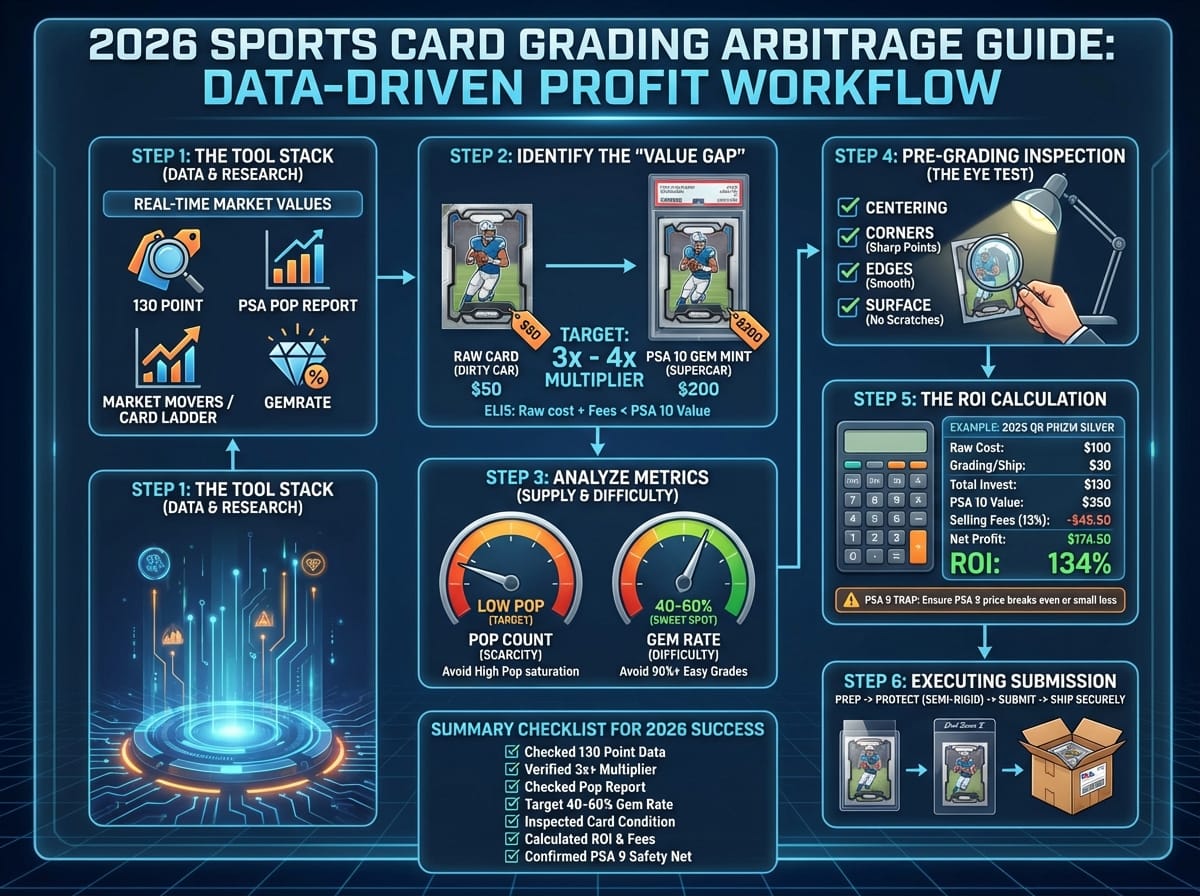
The modern sports card market has evolved from a nostalgic hobby into a data-driven asset class. In 2026, the strategy known as “grading arbitrage”—buying raw (ungraded) cards and submitting them to PSA for a grade—remains one of the most effective ways to generate profit. However, the days of blind submissions are over. To succeed today, you need a calculated approach.
This guide provides a comprehensive workflow to identify modern football cards with high flipping potential, utilizing the latest tools and metrics available in the 2026 market.
Step 1: The Tool Stack – Where to Look
Before buying a single card, you must understand market values. Relying on “listed prices” is a rookie mistake; you need data on actual cash transactions.
Essential Research Tools
- 130 Point: The gold standard for checking “sold” listings. It scrapes eBay data and reveals the actual price accepted on “Best Offer” listings, which eBay often hides.
- PSA Pop Report: The official census of how many copies of a specific card exist and their grades.
- Market Movers / Card Ladder: Premium software suites that track indices and historical price movements (great for spotting trends).
- GemRate: A specialized tool for analyzing grading trends and probabilities.
Step 2: Identifying the “Value Gap”
The core of this strategy is finding a card where the price difference between a Raw version and a PSA 10 version covers your costs and leaves room for profit.
ELI5 (Explain Like I’m 5): Imagine buying a dirty vintage car for $5,000. You spend $1,000 washing and fixing it. If you can sell the shiny car for $10,000, you made money. If the shiny car only sells for $5,500, you lost money. We are looking for “dirty cars” (raw cards) that become “supercars” (PSA 10s) after we “wash” them (grade them).
The Golden Ratio
In 2026, a safe rule of thumb is the 3x to 4x Rule. The PSA 10 value should be at least 3 to 4 times the price of the raw card. If a raw card costs $50, the PSA 10 should consistently sell for $150–$200 to justify the risk.
Step 3: Analyzing The Metrics (Pop Count and Gem Rate)
Not all cards are created equal. You need to analyze the supply and the difficulty of grading.
Understanding “Pop Count” (Population Report)
The Pop Count tells you how many of these cards exist in a PSA holder.
- High Pop: If there are 20,000 PSA 10s of a base rookie card, the price will likely stagnant or drop because supply is huge.
- Low Pop: If there are only 50 PSA 10s, the card is scarce, which can drive up value.
Analyzing the “Gem Rate”
The Gem Rate is the percentage of submitted cards that receive a perfect PSA 10.
ELI5: Think of this like a difficult math test. If the test is easy and 90% of the class gets an A+ (High Gem Rate), the A+ isn’t very impressive. If the test is impossible and only 10% get an A+ (Low Gem Rate), that grade is extremely valuable.
- Avoid: Cards with a 90%+ Gem Rate. The market will be flooded with 10s, crashing the price.
- Target: Cards with a 40–60% Gem Rate. This indicates the card is hard enough to grade that a 10 is a premium, but not so impossible that you will likely fail.
Step 4: Pre-Grading Inspection (The Eye Test)
Never buy a raw card online without high-resolution images. When you have the card in hand, you must inspect it under a bright light with magnification. PSA judges on four criteria:
- Centering: Is the picture perfectly in the middle? (Look at the borders; they should be even).
- Corners: Are they sharp points? (White specks on corners = automatic PSA 8 or 9).
- Edges: Are they smooth? (Look for chipping or roughness).
- Surface: Are there scratches, print lines, or fingerprints? (Wipe chrome cards with a microfiber cloth).
Step 5: The ROI Calculation
Before submitting to PSA, you must calculate your Return on Investment (ROI). In 2026, grading fees, shipping, and selling fees must all be accounted for.
The Formula
(Projected Sale Price – Selling Fees) – (Raw Cost + Grading Fee + Shipping) = Net Profit
Example Scenario: 2025 Prizm Rookie Quarterback
Let’s pretend we are looking at a Silver Prizm of a star Quarterback.
| Expense / Item | Cost / Value | Notes |
|---|---|---|
| Raw Card Cost | $100.00 | Purchase price including tax/ship. |
| PSA Grading Fee | $25.00 | Based on 2026 Value Bulk rates. |
| Shipping (To/From PSA) | $5.00 | Amortized across a bulk order. |
| Total Investment | $130.00 | The money you have locked up. |
| PSA 10 Market Value | $350.00 | Based on recent eBay solds. |
| eBay Selling Fees (13%) | -$45.50 | Fees vary, but 13% is standard. |
| Net Payout | $304.50 | Cash back in hand. |
| Net Profit | $174.50 | Total Profit. |
| ROI | 134% | (Profit / Investment) * 100. |
The PSA 9 Trap
You must also calculate the “worst-case scenario.” If the card gets a PSA 9, will you lose money?
If a PSA 9 sells for $110 (after fees = $95), and your total cost was $130, you lose $35. Only flip cards where a PSA 9 allows you to break even or take a very small loss.
Step 6: Executing the Submission
Once you have identified the card, inspected it, and confirmed the math works:
- Prep: Place the card in a clear penny sleeve.
- Protect: Insert the sleeved card into a semi-rigid holder (Card Saver 1). Do not use magnetic cases or screw-downs for submission.
- Submit: Create an account on the PSA website, fill out the submission form, and print your packing slips.
- Ship: Pack the cards securely in cardboard (sandwich method) and ship with insurance.
Summary Checklist for 2026 Success
- [ ] Checked 130 Point for accurate Raw vs. PSA 10 pricing.
- [ ] Verified the Multiplier is at least 3x (Raw to PSA 10).
- [ ] Checked Pop Report to ensure market isn’t oversaturated.
- [ ] Checked Gem Rate (aiming for 40-60%).
- [ ] Inspected card for centering and sharp corners.
- [ ] Calculated ROI including fees and shipping.
- [ ] Confirmed PSA 9 price acts as a safety net.
